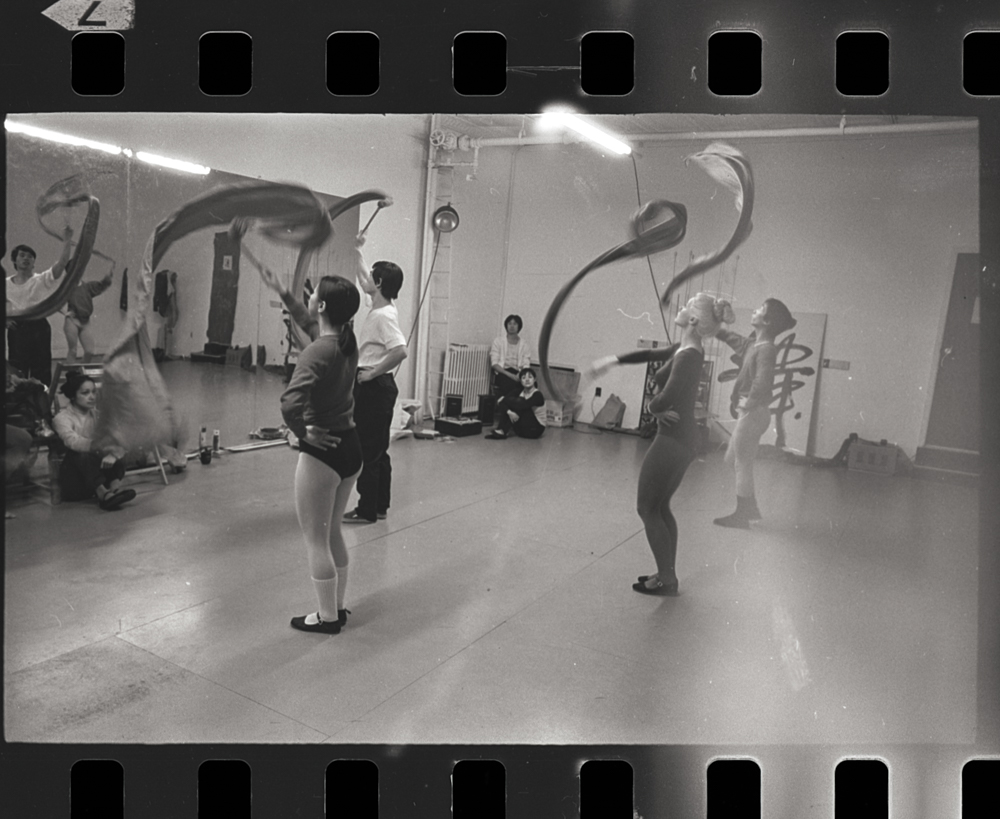
Emile Bocian was a Polish-Jewish-American photographer who worked as a photojournalist for The China Post in Manhattan’s Chinatown. Among his negatives from the 1970s is a precious photographic record that captures Chinese dancer and choreographer Chiang Ching during her very first year with her dance company.
Chiang Ching (江青) was born in 1946 in Beijing, though her family was originally from Puning, Guangdong Province. Her birth name was Chiang Tu Ching (江独青). In the 1950s, her mother, responding to the communist state’s call for “self-reform,” removed the character “独(Tu)” (meaning “alone”) from her name, thus renaming her Chiang Ching. At age ten, she was admitted to the Beijing Dance Academy, where she received six years of professional training in ballet and Chinese folk dance. On the eve of graduation in 1962, Chiang Ching went to Hong Kong to visit her family, and due to their persuasion, did not return to mainland China. While in Hong Kong, Chiang Ching auditioned for and was accepted into the Shaw Brothers’ Southern Experimental Drama Troupe. Over seven years, she starred in more than twenty films, including Seven Fairies (七仙女) and Xi Shi (西施). In 1967, she won the Best Actress award at the fifth Golden Horse Awards in Taiwan.
Despite her tremendous success in cinema, Chiang Ching never forgot her first love—dance. In 1970, following an unsuccessful marriage, she left the film industry and set off alone for the United States, where she taught Chinese dance while studying modern dance. In 1973, she founded the Chiang Ching Dance Company in New York. The photographs taken by Emile Bocian in 1974 capture precisely this period of her life, offering a glimpse into the dance company’s formative first year.
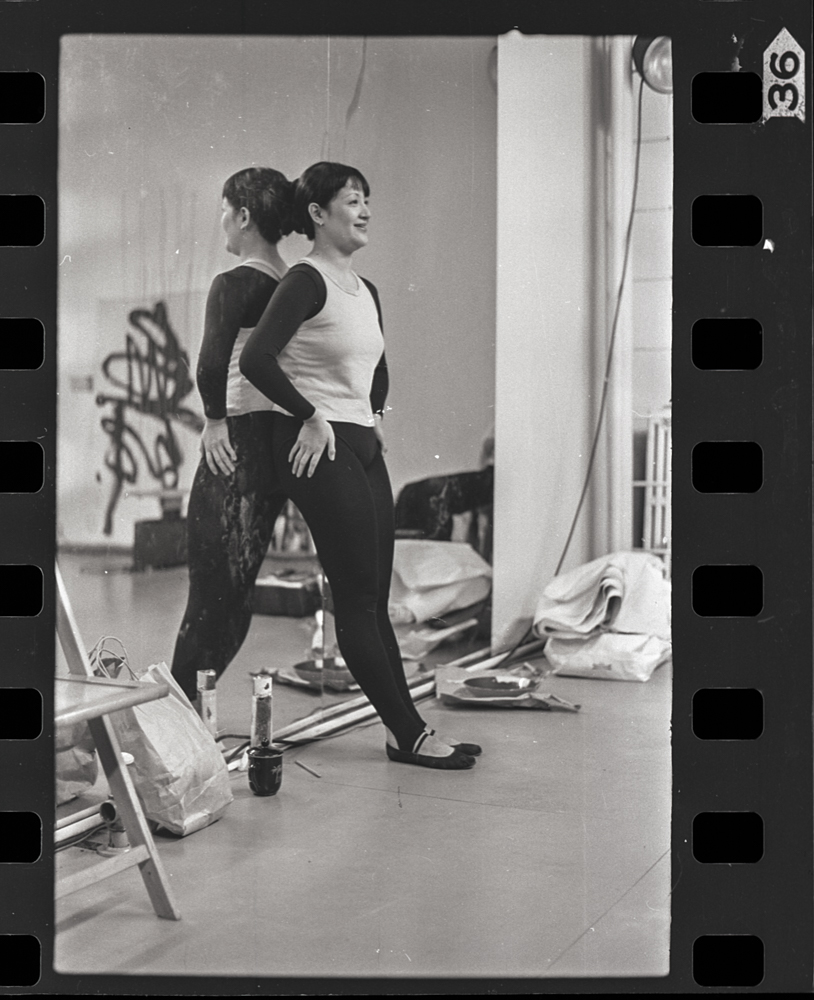
2025.002.388-18 Chiang Ching standing in front of the mirror. Photograph taken by Emile Bocian, 12.1.1974.
In her autobiography, Chiang Ching: Past Stories, Past Times, Past Thoughts (《江青的往事往时往思》), Chiang Ching recalls her dance studio:
“In 1974, I finally found a loft in New York’s SoHo—about 2,500 square feet with a fourteen-foot ceiling. After renovating, I lived in the rear third, and the front two-thirds became the dance studio for my company. I painted the entire space white and installed large mirrors along one whole wall, making it feel quite spacious. Having my own space gave me a burst of creative energy. With work and home in one place, my daily routine became irregular. Eating lunch in my dance clothes in the back, or gesturing and choreographing in my robe in the middle of the night—that became perfectly normal.”
A calligraphic character “舞” (dance), painted by Taiwanese artist Hsia Yan (夏阳), continued to grace the wall of Chiang Ching’s studio for over thirty years. The lighting design for the studio was created by Chiang Ching’s friend David Kissel. Kissel had just graduated from New York University’s drama department, specializing in lighting design. At the time, Chiang Ching was busy with company administration, choreography, and performances, supporting herself mainly through teaching dance. Money was tight for this young dance company, so the studio’s lighting design was born of practical, cost-saving ingenuity. Using discarded tin cans collected from Chinese restaurants, Chiang Ching and Kissel hand-built a fully functional lighting system of overhead, front, area, and spot lights with dimming capability. Through installing this lighting system, the dance studio became both a creative laboratory and a training ground: Chiang Ching could refine works through in-house previews and repeated revisions before public performances, while Kissel gained practical stage experience. For the two emerging artists and their young company, the SoHo dance studio became an essential catalyst for artistic growth and innovation.
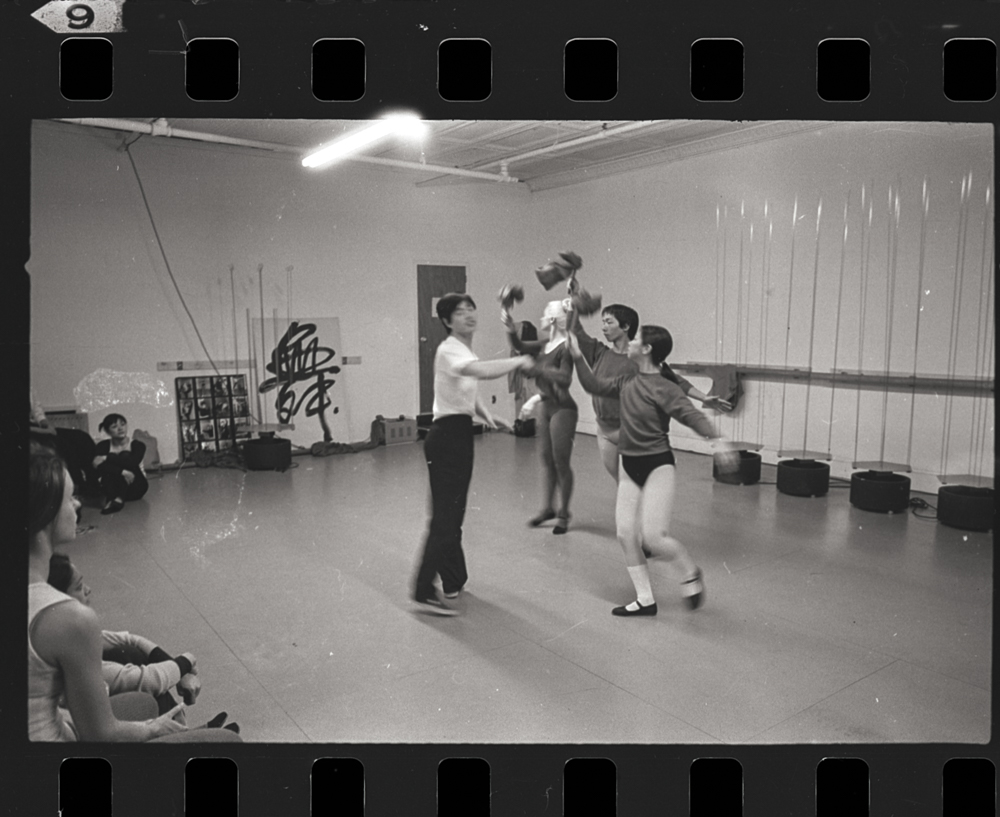
2025.002.388-32 During a dance rehearsal at the SoHo studio. On the left is the calligraphic character “舞” (dance), painted by Taiwanese artist Hsia Yan (夏阳). Against the wall on the right is a series of cybernetic sculptures created by American sculptor Wen-Ying Tsai (蔡文穎), who was collaborating with Chiang Ching on their work Pien (变). Photograph taken by Emile Bocian, 12.1.1974.
In 1974, the year preserved through Emile Bocian’s lens, Chiang Ching and her company members settled into the newly renovated SoHo studio, where they rehearsed and produced works such as Yang Kuan (阳关), Soliloquy of a Bhiksuni (尼姑的独白), and Pien (变). In these works, Chiang Ching fused the creative language of Western modern dance with Chinese aesthetics, drawing inspiration from Chinese poetic and folk traditions, establishing a distinctive choreographic style of her own. Members of Chiang Ching Dance Company who appeared in these 1974 photos include Lu Chih-Ming, Linda Dobson, Lily Gee, Lynette Chun, Oliver Tessier, and Benton Wong. In one of Bocian’s photographs, Chiang Ching is seen with the stage drapery designed for her solo in Soliloquy of a Bhiksuni, painted by the artist Hsia Yan (夏阳). In another Bocian photo of the studio, against the wall on the right is a series of cybernetic sculptures created by American sculptor Wen-Ying Tsai (蔡文穎) for Chiang Ching Dance Company’s work, Pien (变).
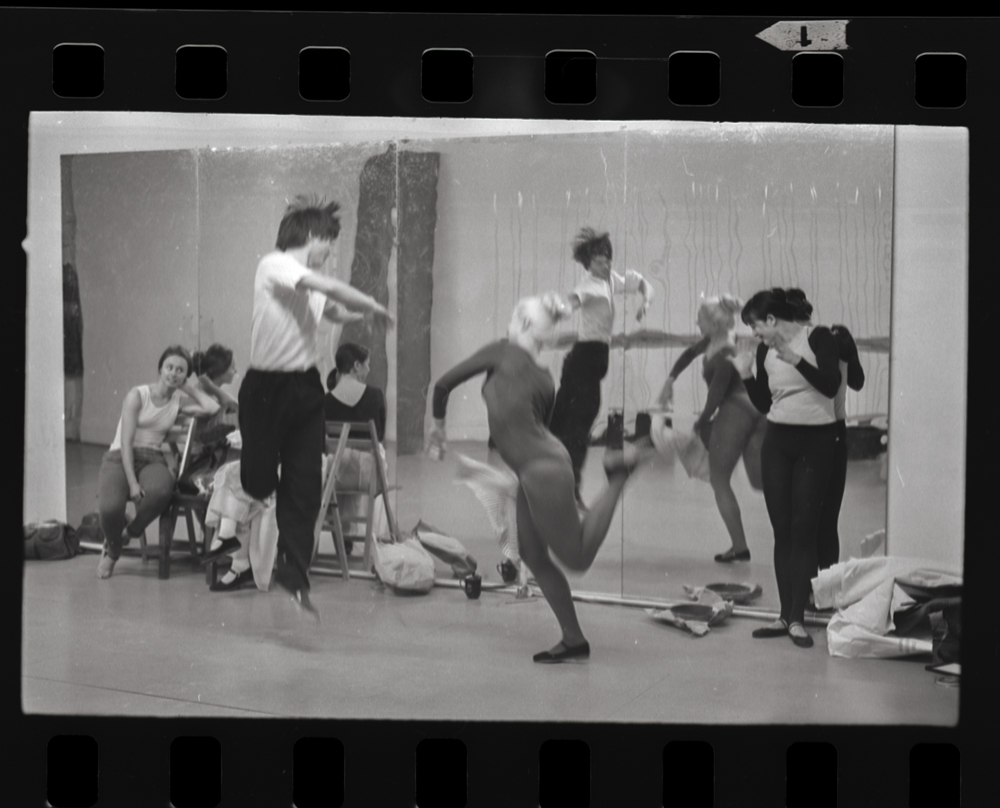
2025.002.387-7 During a dance rehearsal at the SoHo studio. From left to right: Oliver Tessier, Lu Chih-Ming, Linda Dobson, Chiang Ching. Photograph taken by Emile Bocian, 12.1.1974.
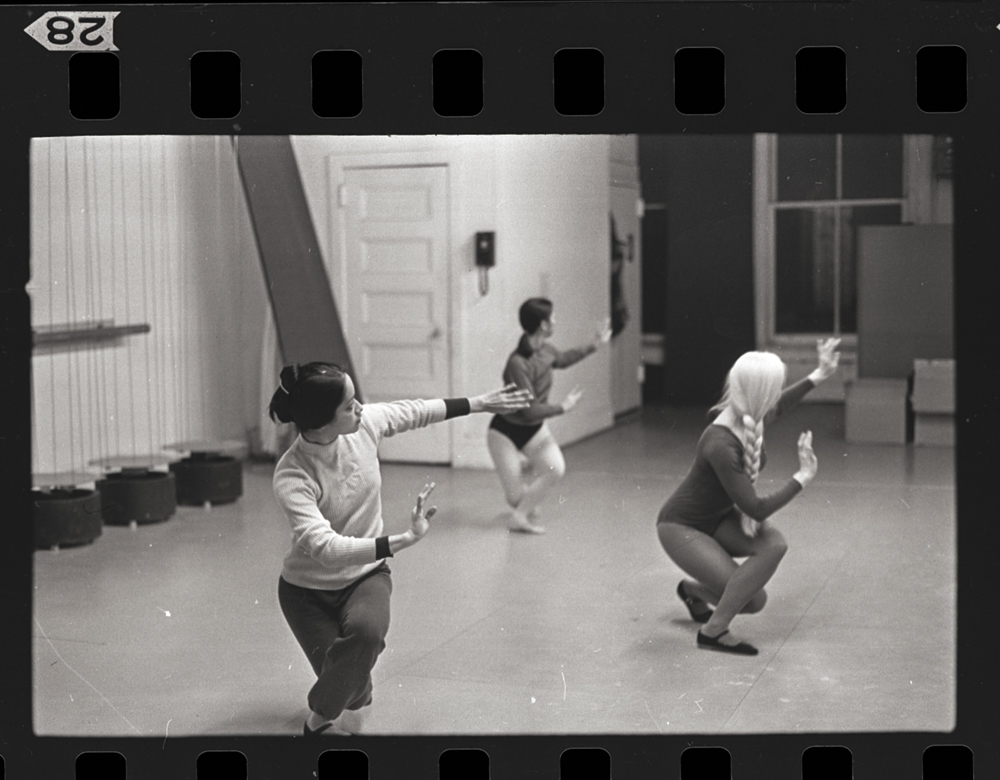
2025.002.388-10 During a dance rehearsal at the SoHo studio. From left to right: Lynette Chun, Lily Gee, Linda Dobson. Photograph taken by Emile Bocian, 12.1.1974.
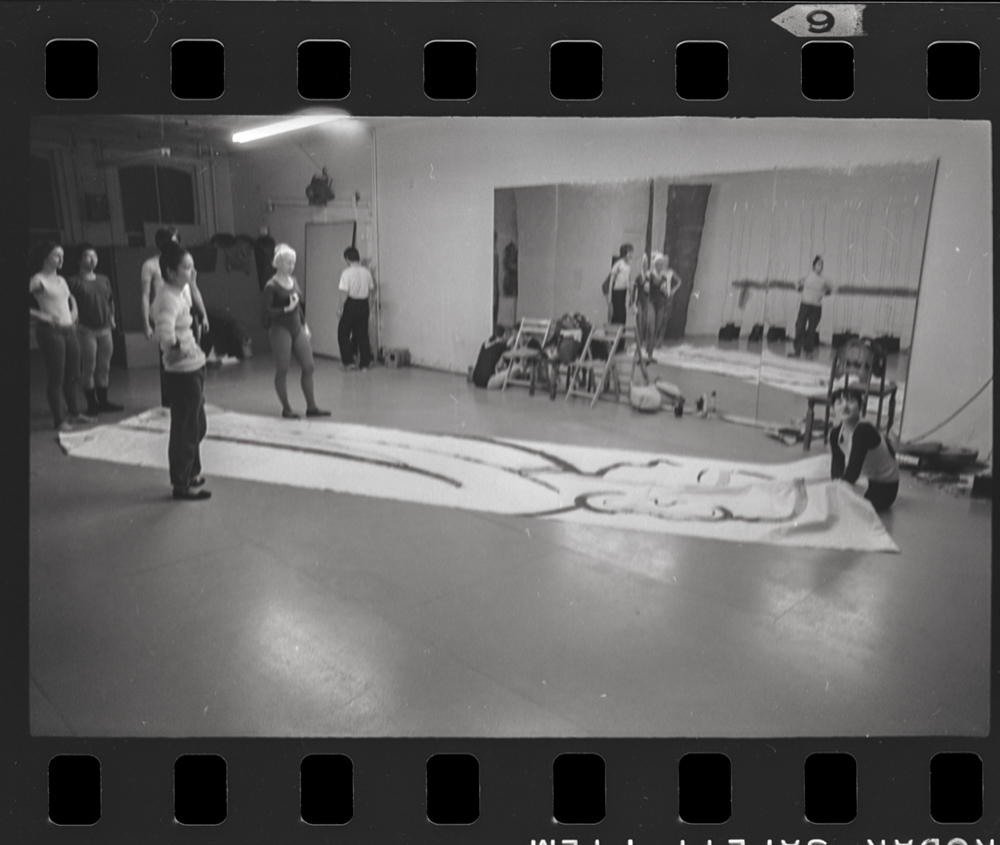
2025.002.387-12 Chiang Ching with members of the Chiang Ching Dance Company. The stage drapery on the floor was painted by the artist Hsia Yan (夏阳) for Chiang Ching’s solo Soliloquy of a Bhiksuni (尼姑的独白). Photograph taken by Emile Bocian, 12.1.1974.
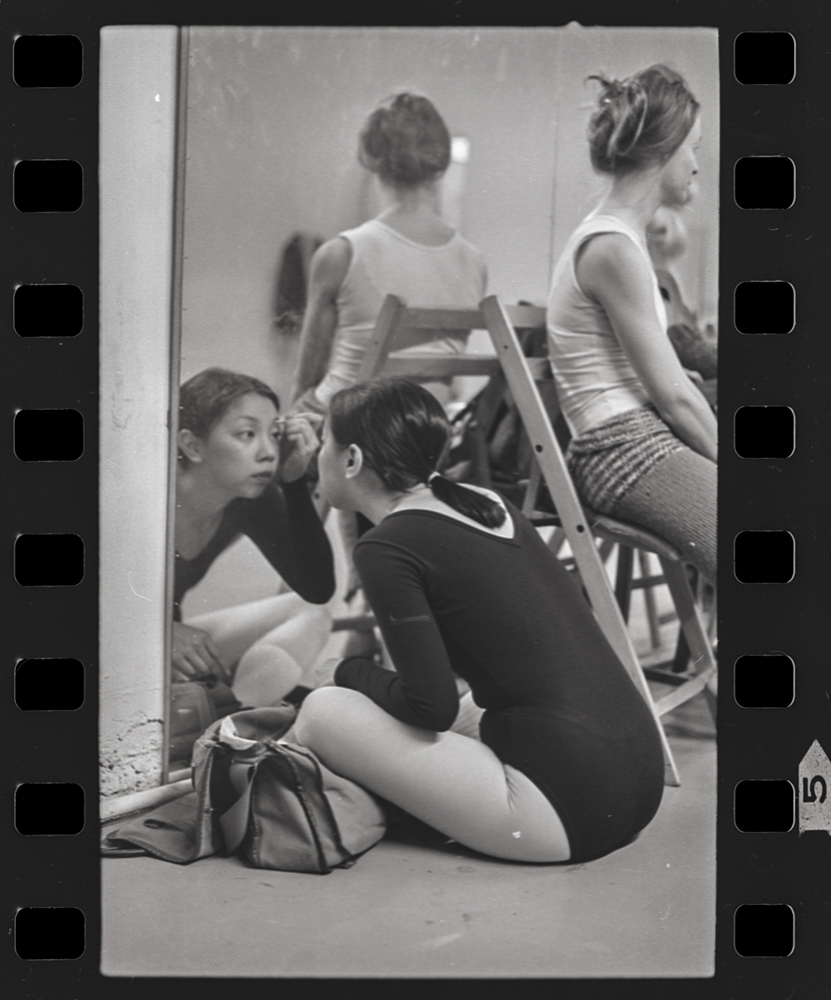
2025.002.387-11 Lily Gee facing the mirror, Oliver Tessier on her right. Photograph taken by Emile Bocian, 12.1.1974.
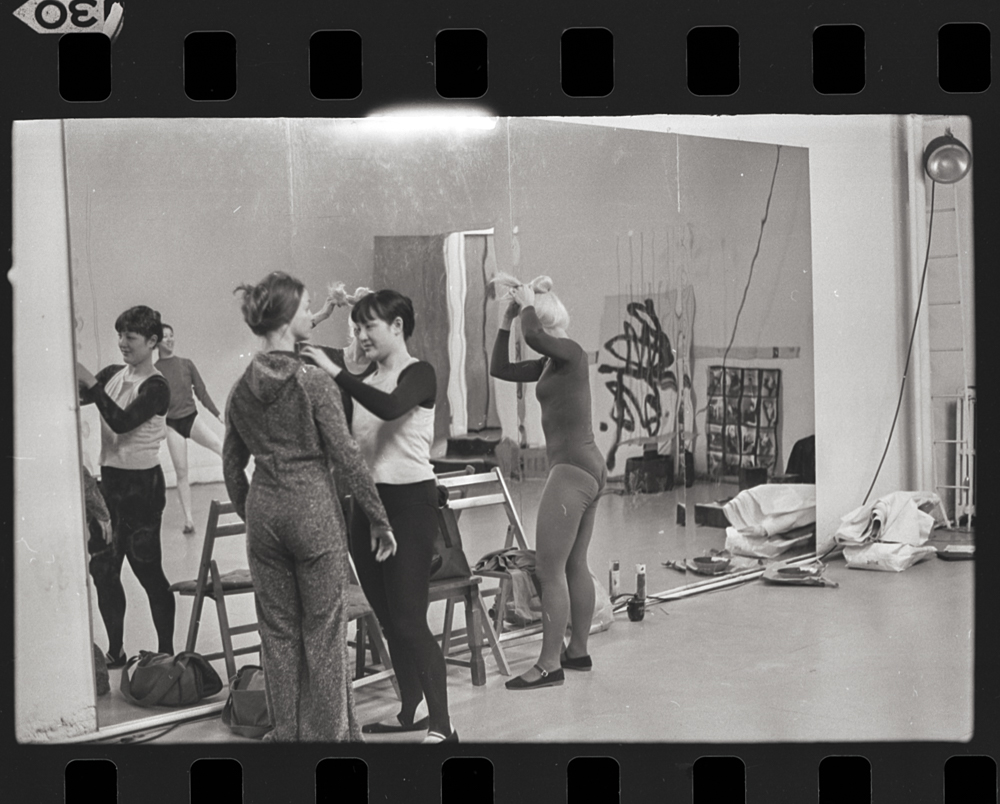
2025.002.388-12 During a dance rehearsal at the SoHo studio. From left to right: Oliver Tessier, Chiang Ching, Linda Dobson. Photograph taken by Emile Bocian, 12.1.1974.
In the decades that followed, Chiang Ching continued to choreograph and perform with remarkable energy, even after disbanding the Chiang Ching Dance Company following her second marriage and moving to Sweden in 1985. Chiang Ching expanded her artistic practice through sustained interdisciplinary collaborations, working with theater directors, visual artists, writers, composers, and musicians from Asia, Europe, and the United States. These exchanges helped her develop a richly layered choreographic language that integrated movement, poetry, music, and visual storytelling.
After the Cultural Revolution ended, Chiang Ching turned her gaze back toward mainland China. At a time when modern dance was still largely unfamiliar there, she traveled frequently to Chinese cities to perform, lecture, and conduct workshops for young dancers and students. Her visits carried both artistic and political significance, reconnecting China with overseas Chinese artists whose creative development had taken place abroad during decades of political separation. In doing so, Chiang Ching played an important role in planting the seeds of modern dance in mainland China and contributing to the emergence of a vibrant modern dance culture.
Seen in retrospect, Emile Bocian’s 1974 photographs mark the beginning of Chiang Ching’s influential international career. Captured in the intimacy of rehearsal, they preserve a moment before global recognition, when experimentation and collaboration shaped the company’s daily practice. Bocian’s photographs document this emergence of a distinct choreographic voice, as Chiang Ching’s work began to express Chinese modernity on the global stage.
By Heather Guo
(The MOCA team is deeply grateful to Chiang Ching for her contribution to this article. Her help identifying the individuals in these dance studio photographs has added invaluable context and enriched our understanding of this artistic community.)
Read more about Chiang Ching’s 1970s works:
https://www.nytimes.com/1975/12/14/archives/chiang-ching-presents-two-dance-premieres.html
https://www.nytimes.com/1979/12/10/archives/dance-chiang-ching-troupe-in-varied-program.html