Collections馆藏Collections馆藏Collections馆藏Collections馆藏Collections馆藏Collections馆藏Collections馆藏Collections馆藏Collections馆藏Collections馆藏Collections馆藏Collections馆藏Collections馆藏Collections馆藏Collections馆藏Collections馆藏Collections馆藏Collections馆藏Collections馆藏Collections馆藏Collections馆藏Collections馆藏Collections馆藏Collections馆藏Collections馆藏Collections馆藏Collections馆藏Collections馆藏Collections馆藏Collections馆藏Collections馆藏Collections馆藏Collections馆藏Collections馆藏Collections馆藏Collections馆藏Collections馆藏Collections馆藏Collections馆藏Collections馆藏Collections馆藏Collections馆藏Collections馆藏Collections馆藏Collections馆藏Collections馆藏Collections馆藏Collections馆藏Collections馆藏Collections馆藏Collections馆藏Collections馆藏Collections馆藏Collections馆藏Collections馆藏Collections馆藏Collections馆藏Collections馆藏Collections馆藏Collections馆藏Collections馆藏Collections馆藏Collections馆藏Collections馆藏
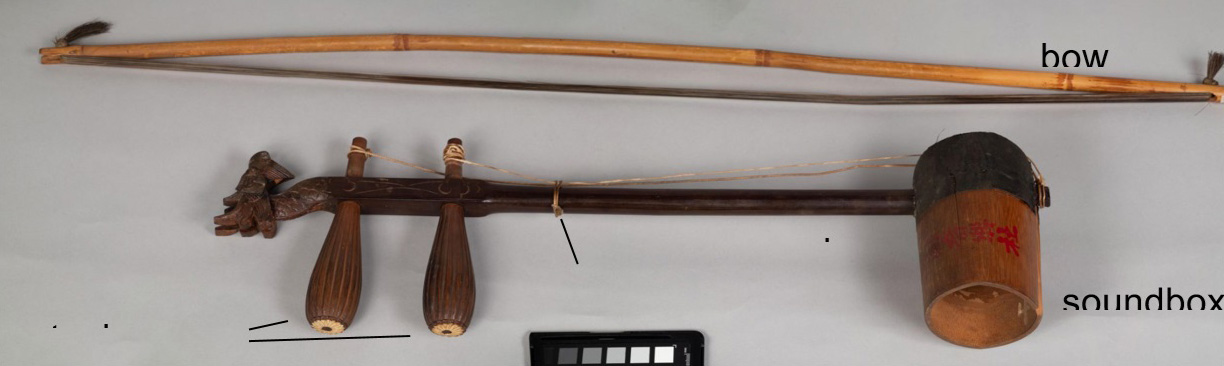
Traditional instrument 1989.002.305 and bow 1989.002.301, MOCA's CMTA Collection.
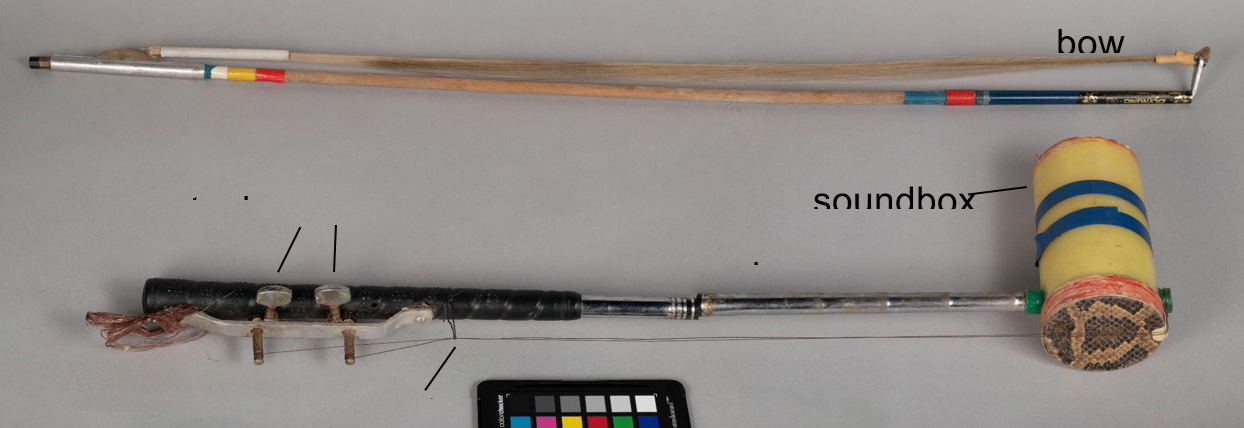
Modern instrument 2023.031.002 and bow 2023.031.003, MOCA's Instrument Collection.

These two instruments may look rather different, but they are both part of the húqin 胡琴—meaning “instrument of the Hu peoples”—family of bowed string instruments from China(Hú was a derogatory term for the indigenous people of northern China, it is most accurately translated to English as barbarians). Húqin instruments include the zhōnghú, gāohú, èrhú, and pipa, among others. Both the traditionally made and modern instruments are, in fact, a Minnan/Cantonese bowed string fiddle called an èrxián 二弦 (“two string”).

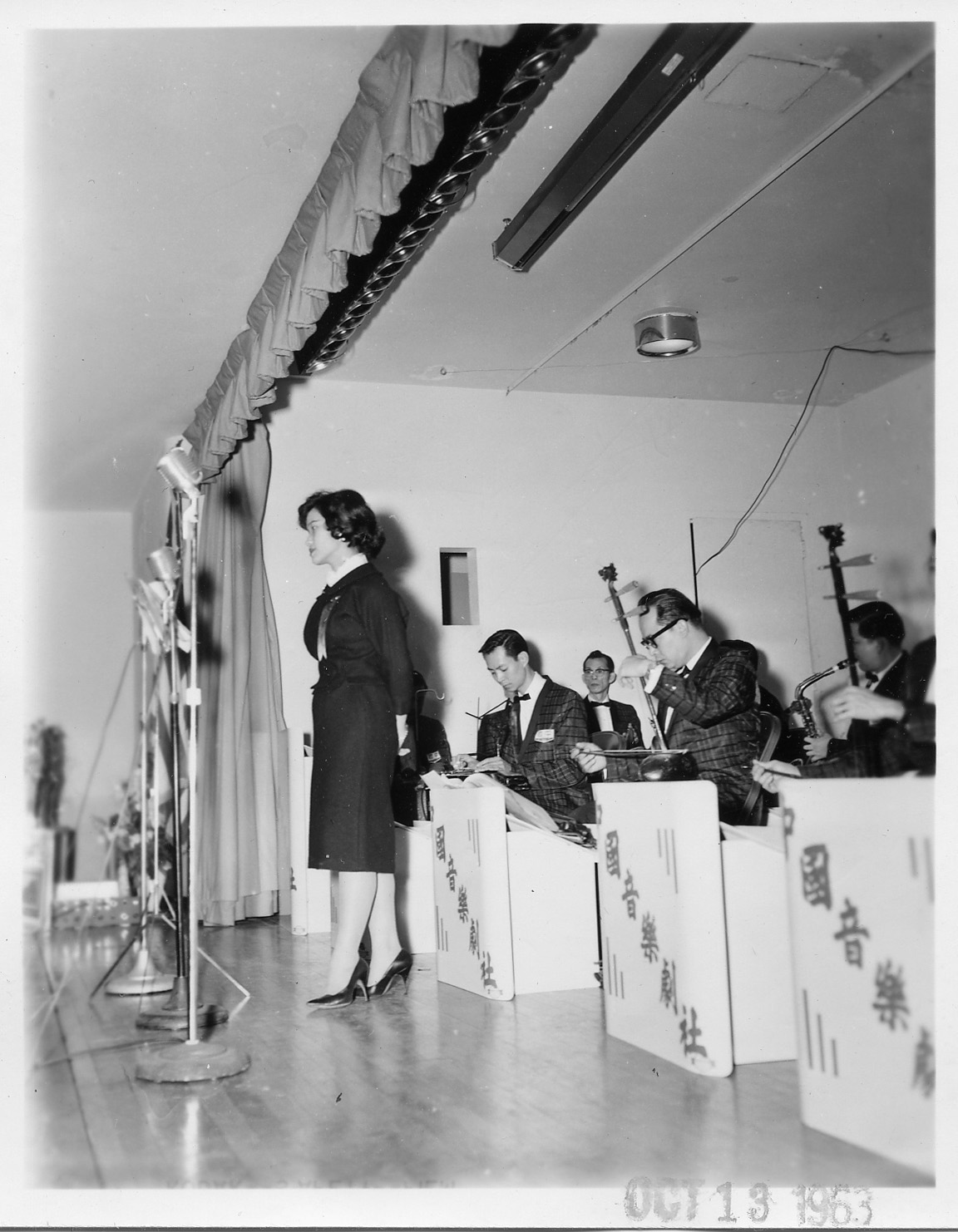
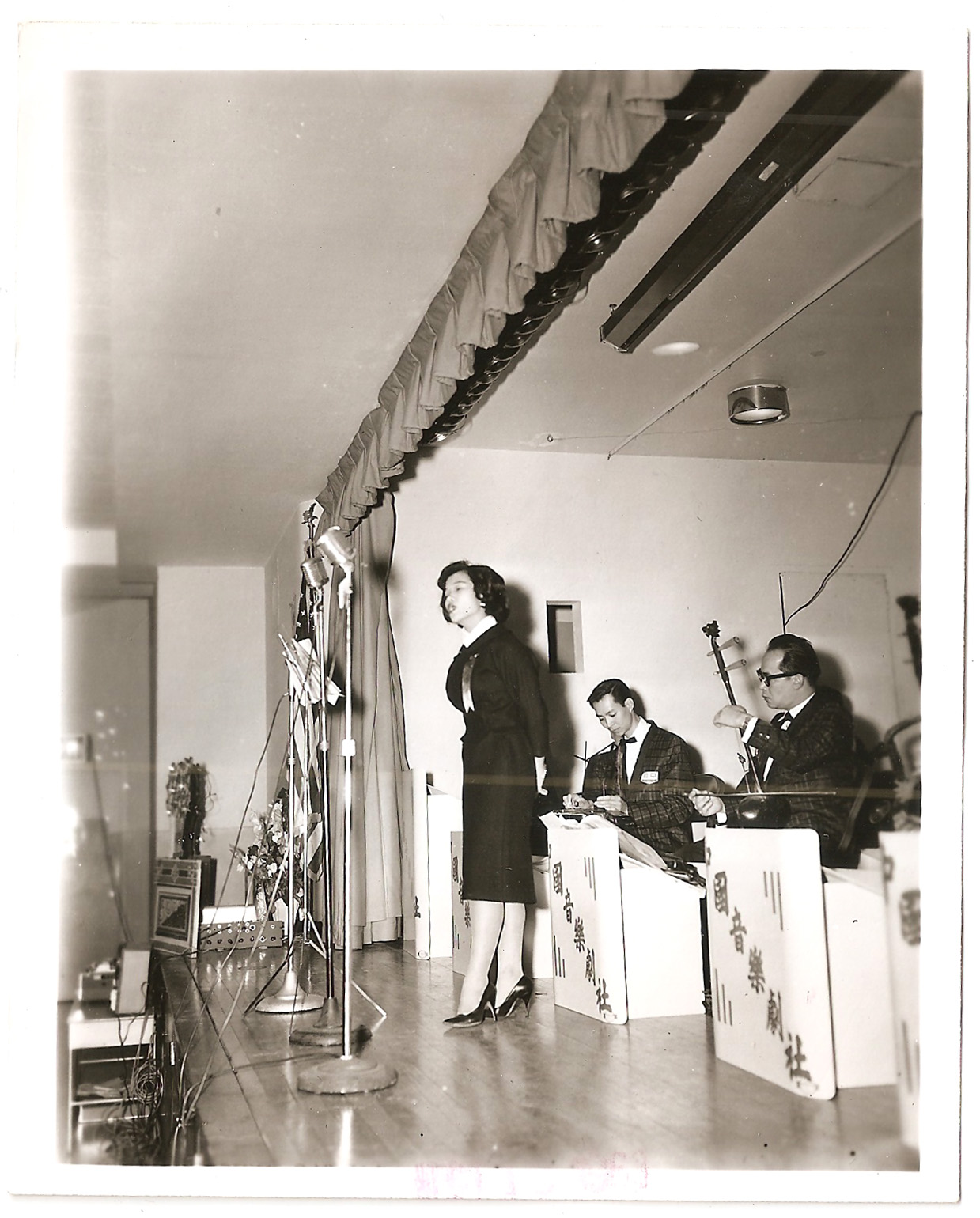
The traditionally made èrxián is part of the Chinese Musical Theatrical Association (CMTA) Collection at MOCA. The CMTA, founded in 1931, performed Chinese opera in NYC, incorporating traditional húqin instruments such as the èrxián and pipa. Two postcards—also from the CMTA Collection—even depict dragon headed fiddles much like this one.

2013.015.068 CMTA performance of Cantonese music, 1963. MOCA's CMTA Collection.
2013.015.077 CMTA performance of Cantonese music, 1963. MOCA's CMTA Collection.

Bowed string fiddles have existed in China since the Tang Dynasty; their predecessors were likely fiddles introduced from Persia through cultural trade along the silk road. For much of its history, the èrxián and associated fiddles were viewed as folk instruments of southern China and only in the 20th century have they become a national art form.

The èrxián is under the sīzhú 絲 (“silk”) classification of instruments, owing to the traditionally silk strings which produce the sound. This classification, called bā yīn 八音 (“eight sound”), is a system whereby instruments are grouped by their material and was first used during the Western Zhou Dynasty. The eight sounds being: bamboo (composed mainly of woodwinds), wood (percussion), stone (chimes), metal (bells), clay, gourd, skin (drums), and of course, silk.

The èrxián is played by placing the base on the left leg, with the left hand fingering the notes, and the right hand holding the bow in an underhand position. The bow hair is slotted in between the two strings and rests on the soundbox while being played. The tone of the èrxián, èrhú, and other bowed instruments in the húqin family is very distinctive, and often described as melancholy, with a nasal pitch.

The major components of the èrxián include the soundbox, the neck, the strings and pegs, and the bow. The soundbox—which is also referred to as the resonator—can be cylindrical, hexagonal, or rectangular. Its front face is covered in a snakeskin, most commonly a python skin because of its flexibility. Situated on the face of the soundbox is a wooden bridge and cloth dampener. It is an unfretted instrument, i.e. no finger board. The nut—or qiān jīn 千斤—is usually a piece of string or metal wire which holds the strings a certain distance from the neck. The inner string (closest to the player) is tied counterclockwise to the top peg, and the outer string is tied clockwise to the lower peg. The bow is most commonly made of horsehair and bamboo, the two strings traditionally were twisted silk, but modern alternatives include nylon or metal.
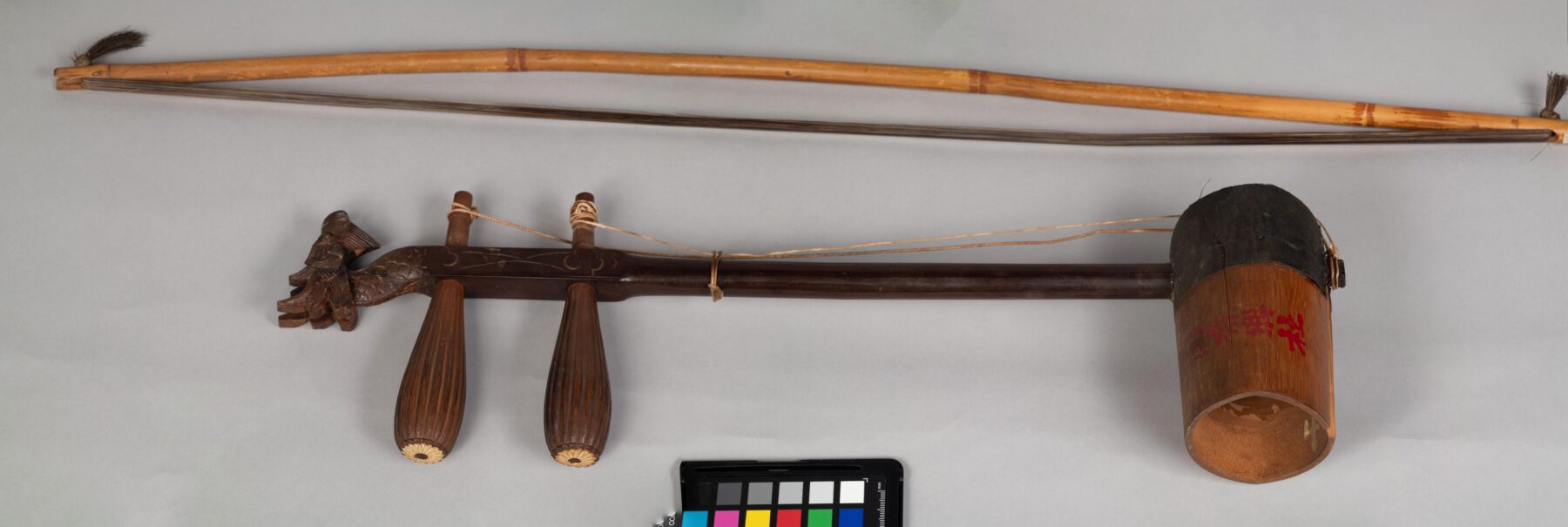
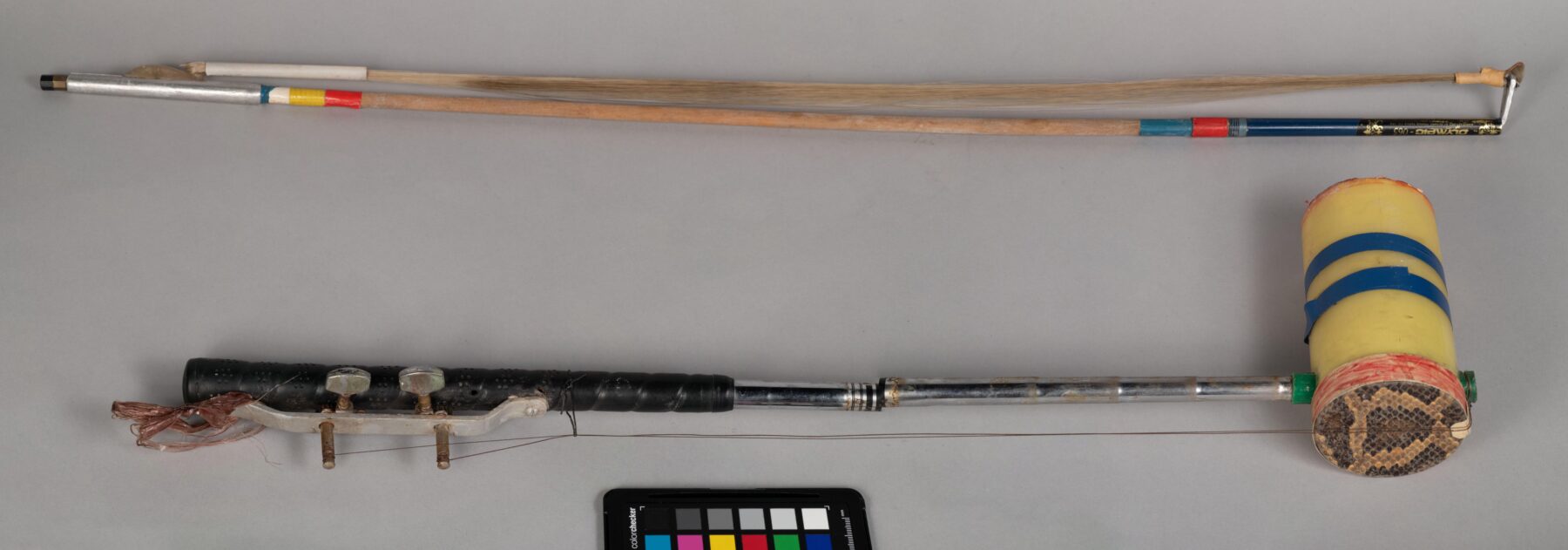
Diagram showing the major components of the traditionally made erxian.
Diagram showing the major components of the modern composite èrxián.

The modern version we have here replaces the wooden soundbox with a plastic tube, the wooden neck with a sawed off golf club, and the two silk strings with metal alternatives. However, the snakeskin remains the same, attached to the soundbox with tape. The modern bow is similarly an assemblage object, with plastic, wood, and tape. Such a composite èrxián is unusual, and a unique object in MOCA’s collection.