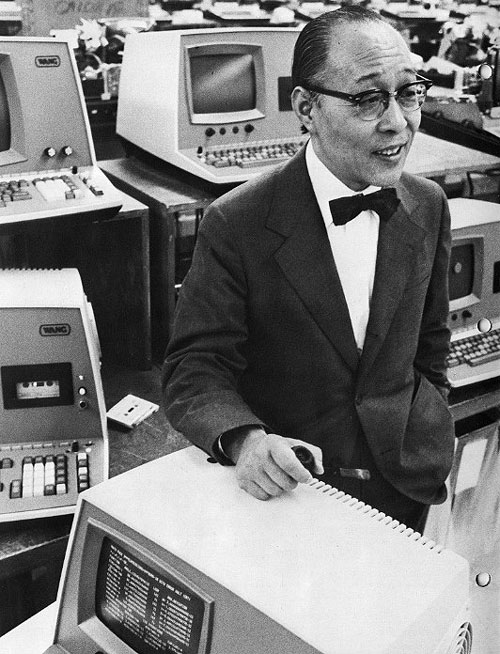
An Wang (February 7, 1920 – March 24, 1990) was a Shanghai-born American inventor and entrepreneur whose invention of magnetic core memory made modern computing possible. The son of an English teacher, Wang showed an early aptitude for mathematics. At just 13, he began attending the elite Shanghai Provincial High School, and in 1940 graduated Chiao Tung University, then widely regarded as the MIT of China. During World War II, Wang fled Japanese-occupied Shanghai for Guilin, where he led a small team that scavenged parts and improvised designs to build radios for military use. As the war drew to a close, Wang placed an impressive second in a highly competitive exam that awarded two years of advanced training in the U.S. to young engineers. Wang used his Nationalist government-sponsored study abroad opportunity to apply to Harvard. There, he earned his M.S. in applied physics in just two semesters in 1946, and went on to earn a PhD in 1948.
After graduating, Wang joined the Harvard Computation Laboratory under Howard Aiken, a pioneer in computing who was then developing the Mark IV, his first purely electronic computer for the U.S. Air Force. It was here, within his first month on the job, that Wang conceived the idea of magnetic core memory. His elegant insight—that data could be read and then immediately rewritten without loss—made fast, reliable, and affordable memory possible. For more than two decades, magnetic core memory powered nearly every computer in the world, making it one of the most important breakthroughs in making modern stored-program computers commercially viable.
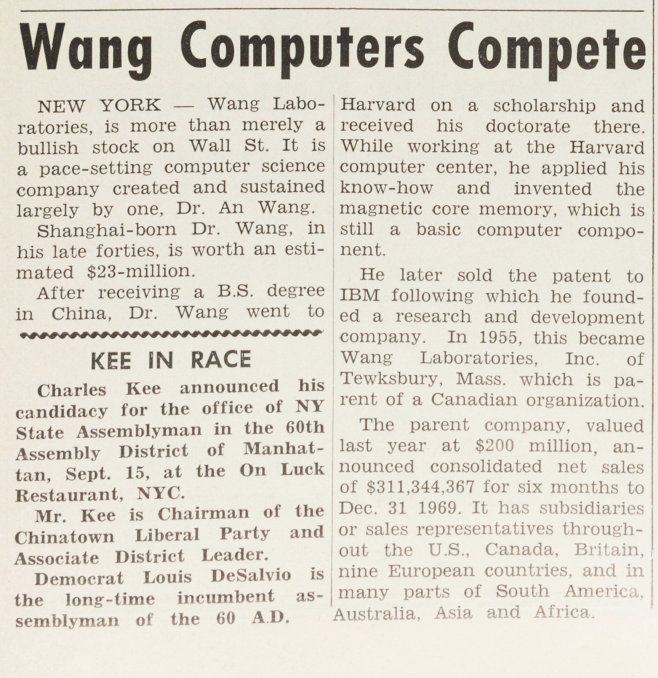
When Harvard discontinued its computer research in 1951, Wang founded Wang Laboratories, initially a one-person company that made and sold magnetic cores. In 1955, Wang sold the patent for his breakthrough invention to IBM and reinvested the proceeds into growing a company that would later compete with IBM. The September 1970 Chinese American Times article below captures a pivotal moment in that rise. Wang had just listed his company on the stock exchange, a move which vaulted Wang Laboratories from a private firm worth roughly one million to a publicly traded company with a market capitalization of about seventy million. By then, the company employed more than 400 people and was beginning to expand beyond its best-selling desktop calculators— the Wang 300—into minicomputers with the Wang 2200, the first models of which were delivered in 1972. In 1978, a highly effective Super Bowl commercial portraying Wang Laboratories as a “David” challenging IBM’s “Goliath” boosted brand recognition among corporate customers from 4 percent to 80 percent.
Before its decline in the 1980s, Wang Laboratories became the world’s leading seller of office equipment and proved that a Chinese name did not preclude success in the fiercely competitive computer industry.