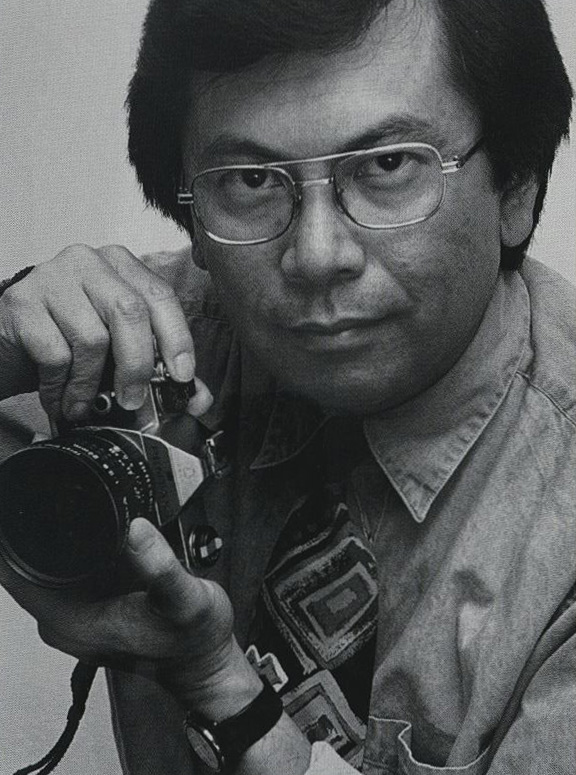
Corky Lee (born Lee Young Quoork (李揚國) on September 5, 1947 in Jamaica, Queens, and commonly written as Lee Young Kok) was a photographer and social justice activist who spent more than fifty years documenting Asian American communities. Rejecting the contemporary pursuit of “high art,” Lee practiced what he called “social photography,” using his camera as a tool to challenge the stereotypes, erasures, and injustices faced by Asian Americans.
Raised in a household of eight and influenced by his father’s experiences living under Jim Crow in Baltimore, Lee developed an early awareness of racial inequality. While helping to run his family’s hand-laundry and working odd jobs to pay for college, he earned a degree in American History from Queens College in 1969 and served as president of the Chinese Student Association. Opposed to the Vietnam War, he sought conscientious objector status and instead completed two years of service at the Two Bridges Neighborhood Council in Chinatown. There, he educated immigrants on their rights, connected elderly residents to social services, and organized tenants across racial and ethnic lines in the “We Won’t Move” rent-strike movement against displacement on the Lower East Side.
It was during this period that Lee first picked up a borrowed camera and began documenting the communities he served. He later joined the Asian Media Collective, a founding component of the Basement Workshop, and worked at Expedi, a pan-Asian leftist printing press that placed him at the center of New York’s growing Asian American political and media networks. The groups he met and the event advertising print orders fulfilled through Expedi enabled him to learn of significant events in advance, ensuring he would be there with camera in hand to document them.
One of the many significant historic moments he captured was the growing tensions between Chinatown residents and the NYPD in the mid-1970s. Lee documented demonstrations that brought thousands of Asian Americans into the streets following the police beating of Peter Yew, a 27-year-old mechanical engineering student who ironically became the target of police brutality himself when he spoke up against police violence being directed against the person he was trying to help. Lee’s photograph of a violent clash between a protester and police, which captured police officers gripping and leading away a still bleeding protestor they had just wounded, was published on the front page of the New York Post. It became one of the most circulated images of the movement up to that time, and has been described as “the sole defining visual for the Asian American Civil Rights Movement.”
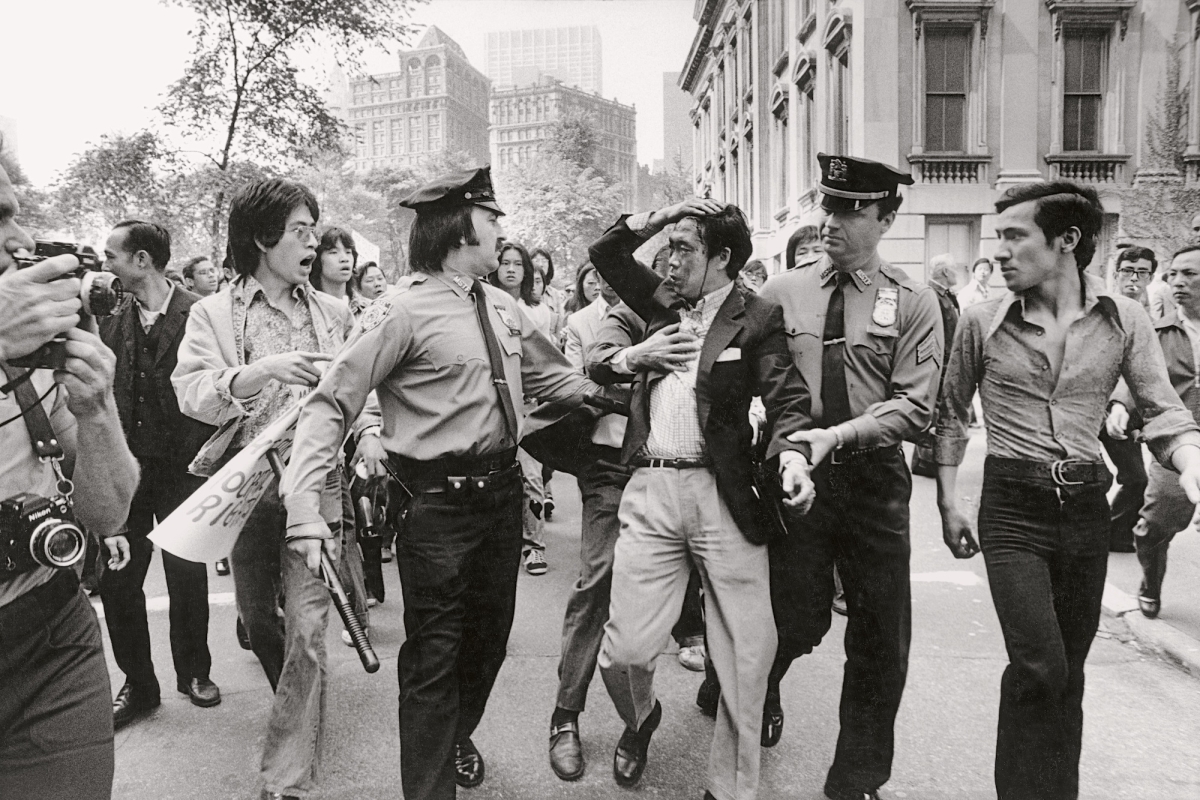
Corky Lee’s iconic photograph capturing protests against the police beating of Peter Yew. It was published on the front page of that day’s issue of the New York Post on May 17, 1975. Photograph taken and copyrighted by Corky Lee.
Beyond political activism, Lee photographed rallies, concerts, community meetings, cultural celebrations, and the everyday rhythms of Chinatown life. Calling Chinatown “a part of my soul,” he captured restaurant workers, factory laborers, and neighborhood youth with the same care he brought to political movements. His photography also served as historical reclamation; in 2014, he organized a restaging and reshoot of the famous 1869 Transcontinental Railroad photograph with workers’ descendants, restoring recognition to the more than 20,000 Chinese laborers omitted from the original image, an effort he described as “photographic justice.”
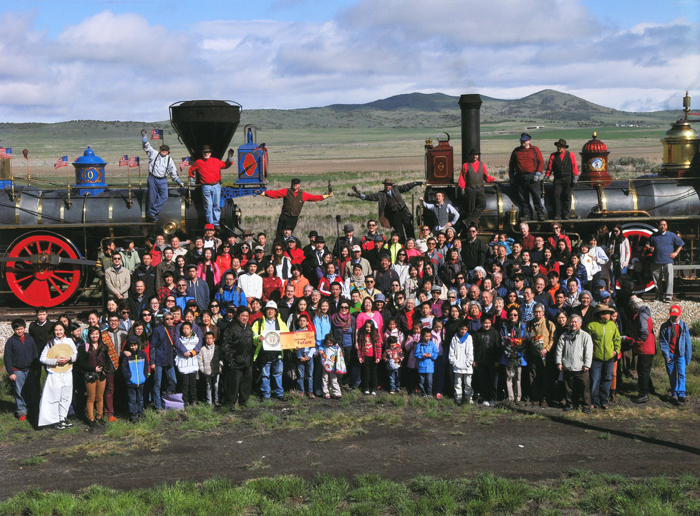
Corky Lee’s recreation of Andrew J. Russell’s 1869 print commemorating the completion of the transcontinental railroad, this time honoring the Chinese workers who actually built the railroad by reenacting the taking of that famous photo with their descendants. Photograph taken and copyrighted by Corky Lee.
Over the course of his career, Lee estimated that he took nearly 200 photographs a week, producing close to half a million images. More than a photographic archive, his work became a visual history of Asian American struggle, resilience, community, and resistance, preserving stories that mainstream institutions often ignored or erased.
By Diamond De La Cruz, MOCA Collections Intern