
Martin Wong (July 11, 1946 – August 12, 1999) was a legendary artist, most famous for his work depicting New York’s Lower East Side in the 1980s. Wong was born in Portland, Oregon and raised in San Francisco. His mother, Florence Wong Fie, who was born in Portland, went back to Guangzhou with her family as a child but returned to the United States in 1940 in light of the Japanese invasion. Wong barely knew his father, Anthony Victor Wong, who died from tuberculosis in 1950 when Wong was only three. He spent a few years in foster care while his mother sought employment, though she visited him frequently. She later married Benjamin Wong Fie, who became Wong’s father figure.
In 1964, Wong graduated from Washington High School and began studying ceramics at Humboldt State University, taking courses like printmaking to supplement his arts education. He also took a summer drawing class taught by Dorr Bothwell and was independently self-publishing poetry. Influenced by his parents, who supported his art practice but worried about its financial viability, Wong transferred to University of California, Berkeley to study architecture in 1966. However, Wong soon dropped out and became engrossed in the burgeoning hippie and counterculture scene of San Francisco. In 1967, during the Summer of Love, he was arrested at a party in Haight-Ashbury, getting his first taste of publicity when his mug shot was published in the San Francisco Examiner. Wong eventually returned to Humboldt State to complete his bachelor’s degree and continued studying ceramics at a graduate level at Mills College. He would later teach drawing at Humboldt in the 1970s. Wanting to expand his artistic horizons, he spent a year in 1971 traveling extensively, visiting European countries including Amsterdam, Italy and Greece. He also went to Afghanistan, where he learned about mosaic tile production, and studied the art and architecture of Pakistan, India, and Nepal. Shortly after returning, he dropped out of Mills. His work had been rejected from a show for using glitter, revealing limitations in ceramics that were intolerable to him. Instead, he turned to painting, a skill he honed as a set designer for the Angels of Light Free Theater.
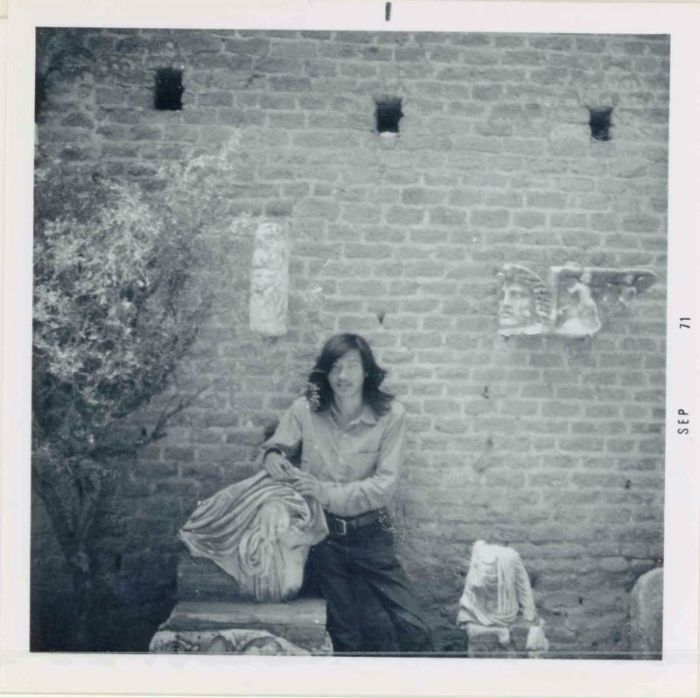
Wong during his travels in Florence, 1971. From “Narrative Chronology | Mark Dean Johnson,” Stanford University Library’s Martin Wong Catalogue Raisonné, https://exhibits.stanford.edu/martin-wong. Copyright © The Martin Wong Foundation.
Between about 1964 and 1978, Wong spent time mostly between San Francisco and Eureka, California, a small city near Humboldt State. He became a fixture in Eureka’s community, creating visual materials like flyers, menus, and cards for local businesses. Wong was also known for his portraiture business, referring to himself as a “Human Instamatic,” and was hired as a courtroom sketch artist for a notable local trial. He loved Eureka and carved out a place for himself in this city with a particularly anti-Chinese history. In 1885, Eureka expelled its entire Chinese population in two days, referred to as the “Eureka Method,” which became a model for further anti-Chinese action in California. Wong’s style at this point mixed San Francisco psychedelic imagery and influences from his travels, but this changed once he moved to New York City.
When he came to New York in 1978, Wong got a room in Meyer’s Hotel, where he lived rent-free for three years by cleaning old rooms and working as the night porter. In these early days, he was famously handed a card with sign language fingerspelling on the subway, a source of influence that would last the rest of his career. Fingerspelling quickly permeated his work, used to create poetry, label places depicted, or convey the latest headlines, like Psychiatrists Testify: Demon Dogs Drive Man to Murder (1980). In an interview with East Village Eye, Wong likened his use of signs in his compositions’ empty spaces to the practice of Chinese landscape painters, saying, “If you look at all the Chinese landscapes in the museums, they have writing in the sky. They write a poem in the sky and I do that, too. That’s 3000 years of art history right there.” Wong completed a residency at New York City’s Department of Transportation in 1990, creating Traffic Signs for Hearing Impaired. The project installed signs using fingerspelling symbols near schools for the deaf to promote awareness and acceptance of the city’s local deaf communities. This endeavor earned him a Special Arts Award from Mayor Dinkins in 1992.
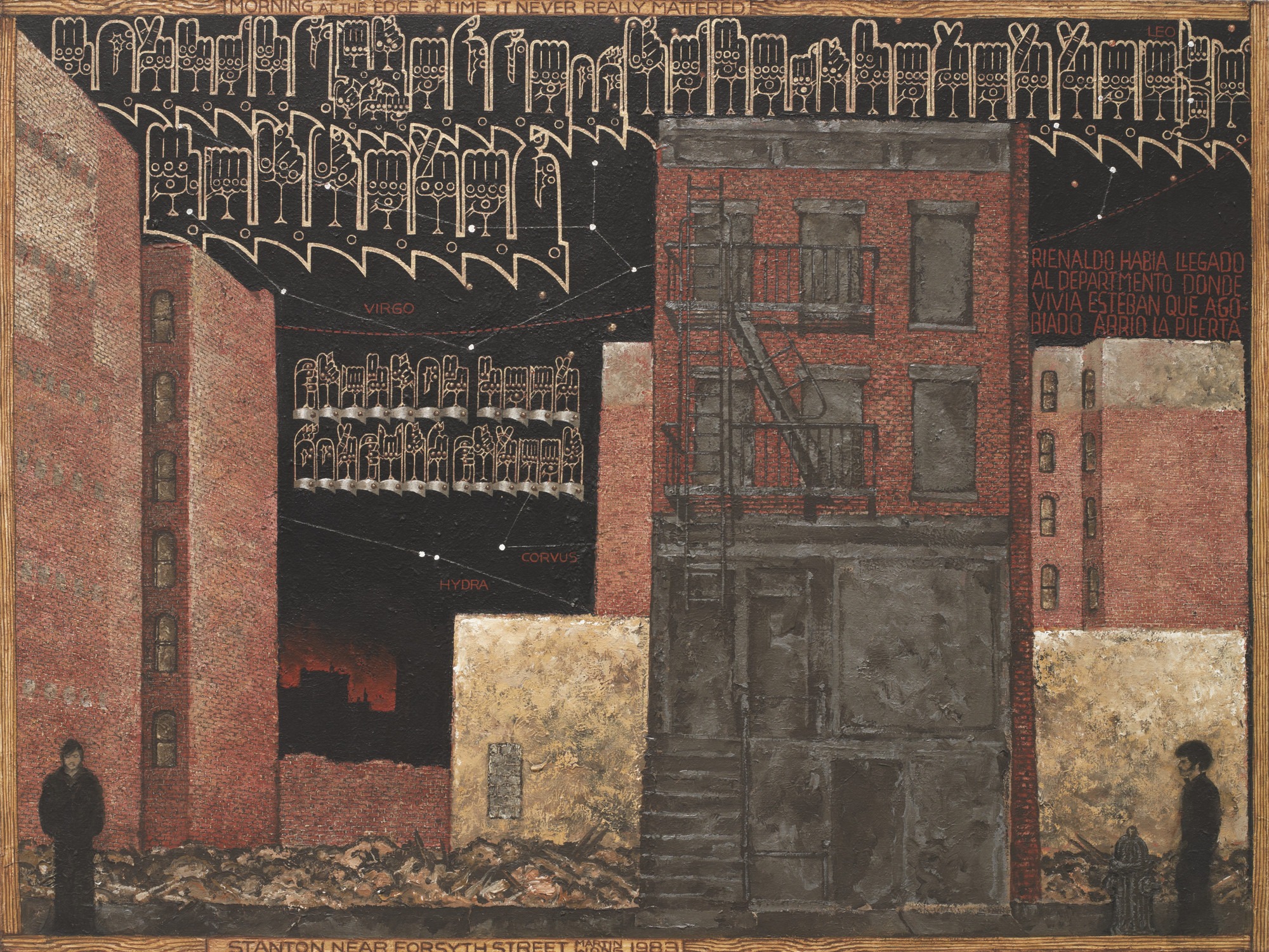
Stanton near Forsyth Street, Martin Wong,1983, acrylic on canvas, Collection of the Museum of Modern Art.
When Wong moved to the Lower East Side in the early ‘80s, his paintings began to focus on his neighborhood, its Puerto Rican community and his soon-to-be signature brick walls and tenements. His most notable muse was Miguel Piñero, an acclaimed Puerto Rican playwright and poet. Piñero moved in with Wong shortly after they met at the painter’s first show, and for a time they had a romantic relationship. They were collaborators. Wong created paintings based on Piñero’s work, such as The Annunciation According to Mikey Piñero: Cupcake and Paco (1984), Wong’s version of a scene from Piñero’s famous play Short Eyes (1974). Wong depicted mostly Latino men in scenes of everyday life in the Lower East Side, as well as homoerotic fantasies and incarceration, which were usually derived from stories Piñero and his friends told about their time as prisoners. He painted a community that he was accepted and integrated into; he was known as “Chino Malo” and “Chino Latino,” an identity that he would not dispute and sometimes entertained in part because his stepfather was of Chinese-Mexican descent. Wong’s paintings of the neighborhood and its culture were works of deep reverence and intimate knowledge, drawn especially from his relationship with Piñero, who unfortunately passed away in 1988.
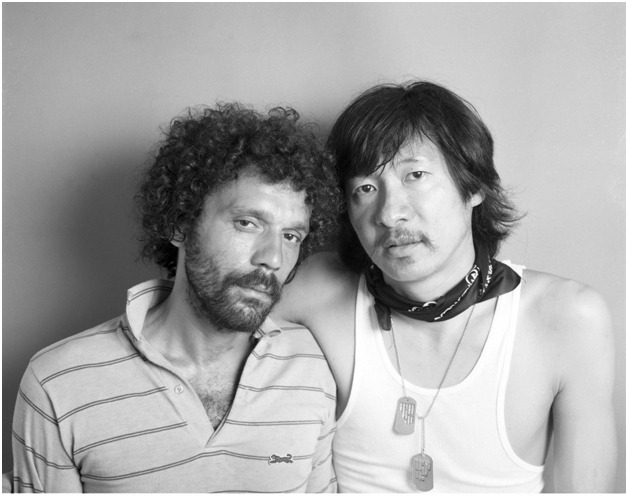
Miguel Piñero and Martin Wong, photographed by Tom Warren, 1984. From “Narrative Chronology | Mark Dean Johnson,” Stanford University Library’s Martin Wong Catalogue Raisonné, https://exhibits.stanford.edu/martin-wong. Copyright © The Martin Wong Foundation.
Piñero’s poetry appeared in Wong’s work, including Attorney Street (Handball Court with Autobiographical Poem by Piñero) (1982-84), which Piñero requested Wong make to record the graffiti art that his friend Little Ivan had tagged. In 1984, Wong’s career reached a turning point when Attorney Street was purchased by the Metropolitan Museum of Art, where he worked in the bookstore in the late 1980s. Wong started becoming associated with other accredited artists of the time, such as David Wojnarowicz and Keith Haring. He was also a leading collector and supporter of graffiti art. When Wong worked at Pearl Paint, he slipped graffiti artists free or massively discounted supplies, and became personally connected to this scene. He befriended figures like Lee Quiñones, who lived with him at one point, and later purchased work from these artists as they were beginning to establish studio practices. Wong cofounded the Museum of American Graffiti in 1985, and although the venture didn’t last long, he later donated this vast collection to the Museum of the City of New York. In both the mainstream and the margins of the ‘80s art world, Wong made strides in his career while uplifting other artists.
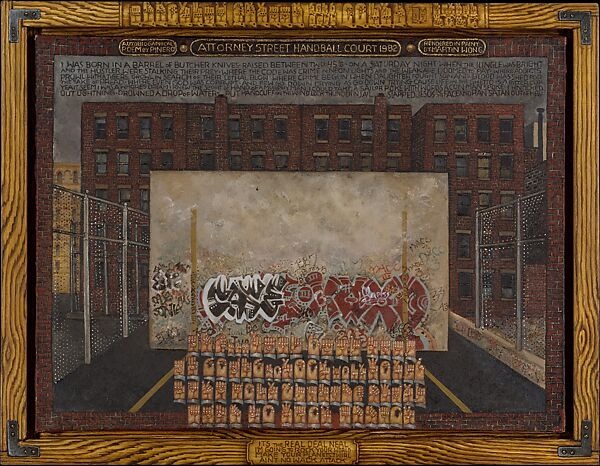
Attorney Street (Handball Court With Autobiographical Poem by Piñero), Martin Wong, 1982-84, oil on canvas. Collection of The Metropolitan Museum of Art, Edith C. Blum Fund.
Wong cited WPA era murals, as well as Mexican muralists, as highly influential to his practice, but observed that Chinese American imagery was completely lacking in the works he revered. In the early ‘90s, Wong created a series of paintings depicting his version of Chinatown. He illustrated childhood memories and commemorated figures like Bruce Lee, Mei Lang-Fang, and his aunt Nora, who had worked at a nightclub in San Francisco’s Chinatown. Some viewed this series as Orientalist due to its over-the-top, sumptuous portrayal of Chinatown, but this Hollywood-esque imagery was quite intentional. Wong was conveying his view of Chinatown both through the lens of his childhood self and as a Chinese American somewhat disconnected from his heritage, a tourist in his own right. He departed from the palette and subject of his most successful Lower East Side paintings, but this series is a distinct and important reflection of how Wong approached identity in his work. It is also another instance of Wong using painting to honor the communities he inhabited throughout his life.
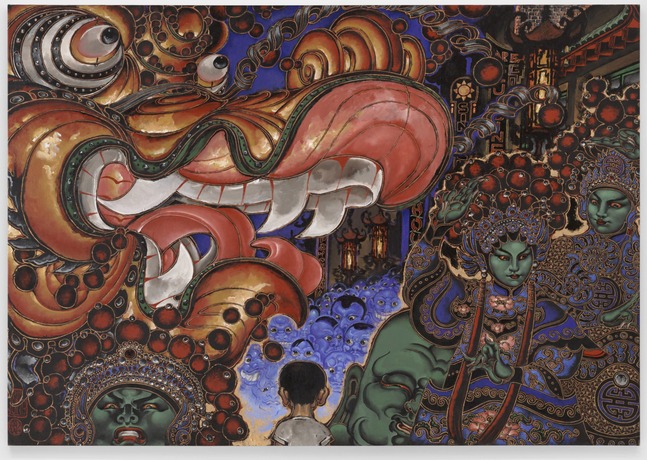
Chinese New Year’s Parade, Martin Wong, 1992-94, acrylic on linen, Collection of the San Francisco Museum of Modern Art.
Unfortunately, Wong was diagnosed with AIDS in 1994. He returned to San Francisco, where he could spend time with and be taken care of by his family and old friends. He painted whenever he had strength, and when his health seriously declined, he had a piece brought to his hospital room so he could continue to work. He painted even on the day that he passed away. In his memory, his mother created the Martin Wong Foundation in 2001, which continues to fund arts programs and provided arts scholarships. Through the foundation and his poignant paintings, Wong is remembered as someone deeply invested in community and self-expression in the face of marginalization, and as an artist who never compromised his vision or the significance his work carried.
By Nikolai Gottesdiener, Bloomberg Arts Intern at MOCA