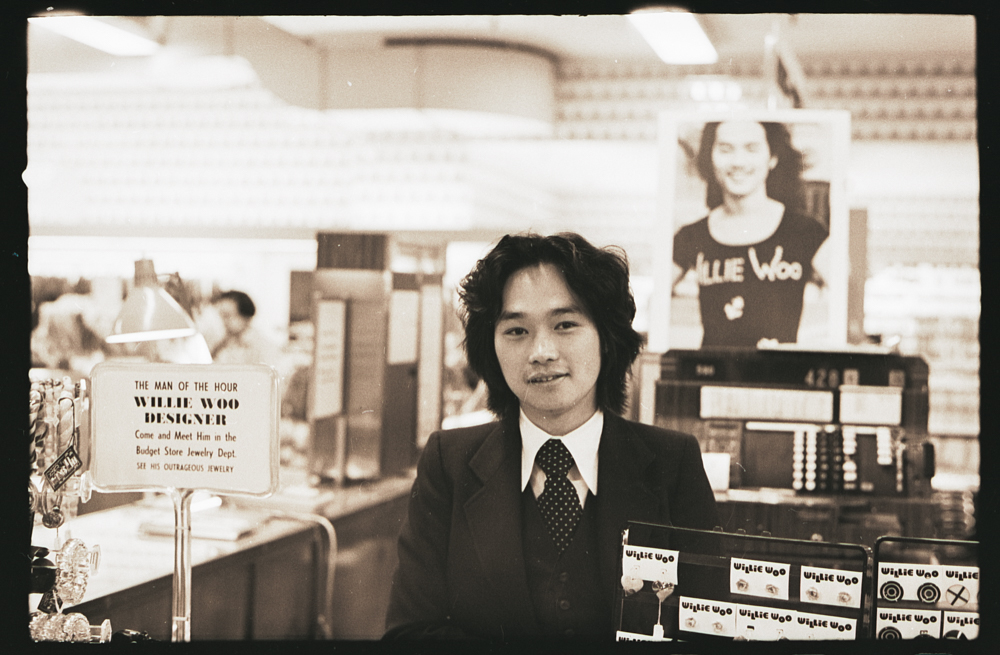
The young man displaying his work is jewelry designer Willie Woo. The photo, taken in 1974, shows the young Hong Kong-born designer already becoming one of the most talked-about names in New York costume jewelry. Woo was one of a small but remarkable cohort of Chinese and Chinese American designers who broke into the American fashion industry in the early 1970s, navigating a market that had rarely made room for them.
Woo came to New York to study and took a job at an import-export firm, an entry-level position that was a common starting point for young Chinese immigrants who had just arrived in the city. He fell into the world of design by accident; while working at the firm, a female co-worker asked him to make her a pin. He readily agreed, and a fashion editor from Vogue happened to see it. That rhinestone pin was the beginning of his bright foray into the fashion world.
Within six months of launching his own line, Woo had appeared on the covers of both Vogue and Life, secured placement at Bloomingdale’s, and earned the nickname that would follow him across continents: the Rhinestone King. His West Side showroom–decorated with red walls, red posters, and red pillows scattered across a black floor–looked nothing like a conventional jewelry showroom.
His designs drew on the visual language of postwar nostalgia and pop abundance: fire hydrants, airplanes, camels, half-moons numbered one through twelve, dresser boys, jellybean bangles, bowling balls, dominoes, and chrome ball necklaces. Reporters consistently noted the humor embedded in each piece, the way a rhinestone jukebox or telephone pin refused to take itself seriously. “Many times women are too serious with jewelry,” Woo told one interviewer. “You should stow away your rocks and have some fun.”
The press could not get enough of him. In city after city–Chicago, Indianapolis, Norfolk, Wichita–fashion editors ran feature stories on the young designer who had upended the rhinestone market. Bill Cunningham, then writing for the Chicago Tribune, covered his collections. The South China Morning Post and Asia Magazine tracked his growing celebrity back home. Woo’s rapid ascent coincided with a broader democratization of fashion jewelry in the early 1970s, when rhinestones shed their associations with cheap imitation and became, briefly, the defining accessory of a generation experimenting with dress as play.
Woo was alert to the limits of riding a single trend. After a summer visit to Hong Kong in 1972, he pivoted into knitwear, metallic lurex, day-glo stripes, halters and turtlenecks, while continuing to expand his jewelry line into “fun and games” territory: jawbreaker necklaces, dice, chrome ball bearings, crystal pendants. He also began planning a move that would position him between two markets, designing in Hong Kong and exporting back to North America.
Although the press coverage of the period consistently framed Woo as a charming novelty–the young immigrant with a quick-laugh personality who had conquered American fashion–his career traced something more deliberate. He understood that fashion fads were perishable and built accordingly by transitioning to new materials, expanding categories, and cultivating relationships on both sides of the Pacific. A manufacturer in Japan was in negotiations to reproduce and sell his jewelry there. His jewelry was carried by Bloomingdale’s, Saks Fifth Avenue, and Lord & Taylor.
His work earned a COTY Award and the admiration of designers, including Issey Miyake. His face appeared on television. And yet, by the late 1970s, Woo had disappeared almost entirely from the public eye. Dubbed the Rhinestone King and celebrated across two continents, he belongs to a longer, still-unfinished project of recovering the Chinese and Chinese American designers, entrepreneurs, and tastemakers whose contributions to American fashion culture have yet to receive their due.
By Vivian Yip, Part Time Collections Project Assistant