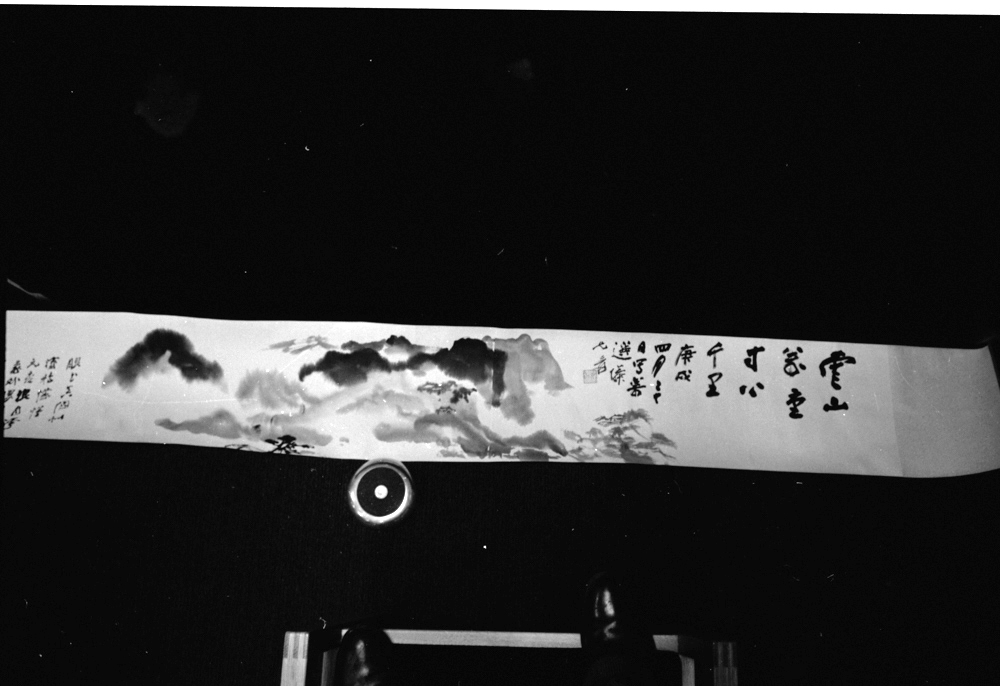
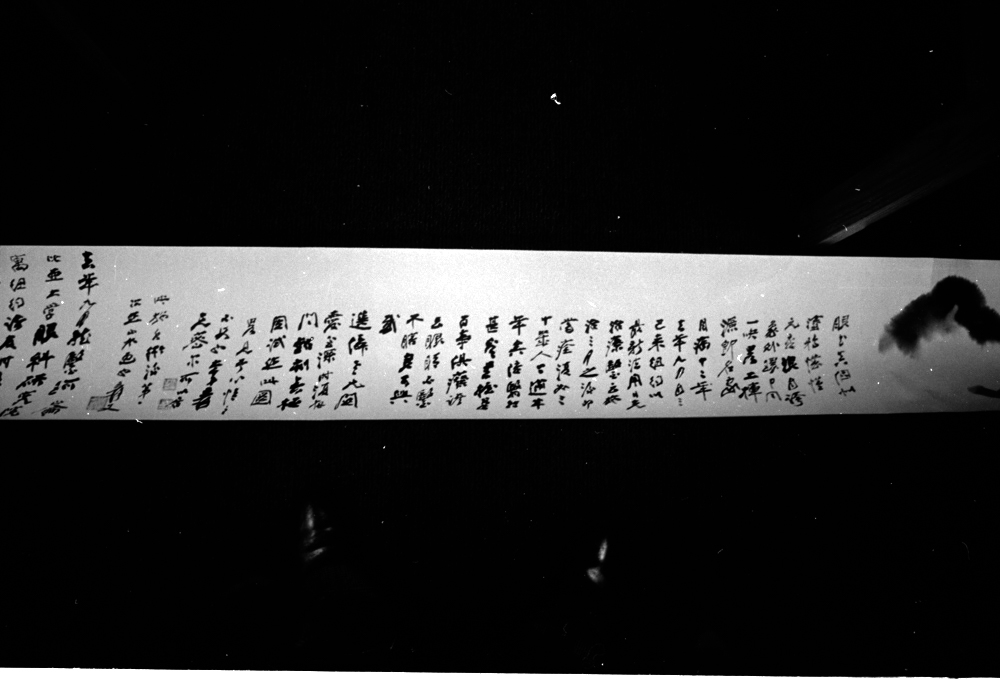
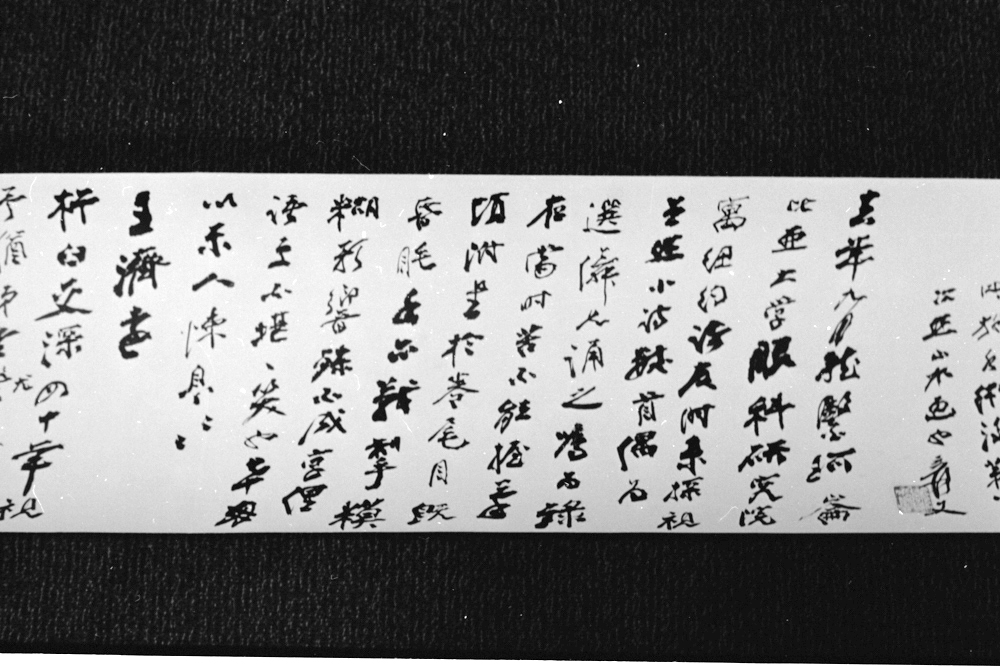
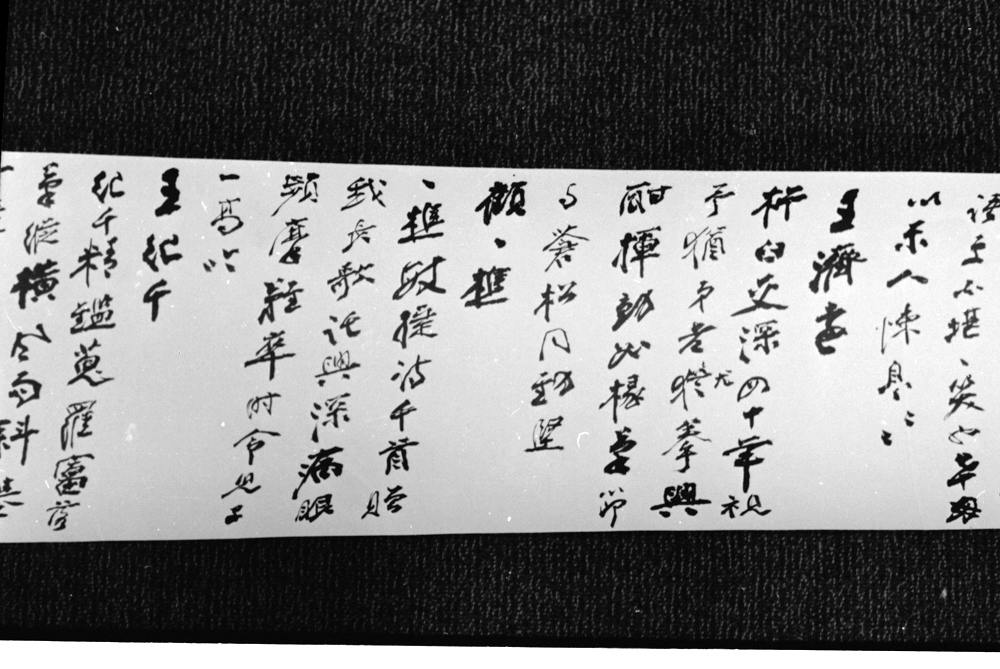
These four photographs depict a freshly completed handscroll titled Endless Mountains and Clouds (雲山千里卷, 1970), painted by the renowned Chinese artist Zhang Daqian (張大千, 1899–1983) and photographed by photojournalist Emilie Bocian (1912–1990). This handscroll, created with ink on paper, features six of the artist’s seals. The artwork is notably large, measuring over 20 feet in length and 11⅞ inches in height.
Zhang Daqian, originally named Zhang Yuan (張爰), is one of the most celebrated and prolific Chinese artists of the twentieth century. Encouraged from a young age to pursue art, Zhang traveled to Kyoto, Japan in 1917 to study textile dyeing techniques. In 1919, Zhang moved to Shanghai, China, to study under two famous calligraphers and painters, Zeng Xi (曾熙, 1861–1930) and Li Ruiqing (李瑞清, 1867–1920). Building on his success in Shanghai, Zhang expanded his career into Northern China throughout the 1920s and 1930s.
By 1949, due to the political climate in China, Zhang left the country. He traveled extensively, exhibited his work internationally, and lived in various places. In 1967, he settled in Carmel-by-the-Sea, California, where he remained until 1978, when he relocated to Taipei, Taiwan, where he lived for the rest of his life.
Endless Mountains and Clouds reflects a six-month period in Zhang’s life, from the fall of 1969 to the spring of 1970. During this time, Zhang underwent months of experimental eye treatments and ultimately eye surgery due to worsening vision caused by glaucoma, cataracts, and ruptured retrobulbar blood vessels. A significant portion of the handscroll consists of poems dedicated to friends who visited and supported him during this difficult time.
The scroll is addressed to “Brother Xuan Wu,” a reference to Gong Xuanwu (龔選舞, b. 1923), a multifield correspondent for the Central Daily in Nanjing, China. In the 1950s, while working in Paris, Gong met Zhang, and the two quickly became friends. Throughout the 1960s and 1970s, many reports on Zhang Daqian’s life and exhibitions abroad were published by Gong in the JoongAng Daily. Gong transcribed the poems dedicated to friends that Zhang recited aloud during his hospital stay. It was Gong who encouraged Zhang to write them down after his medical procedures were completed.
The entire calligraphy has been transcribed into traditional Chinese in the book The Collected Poems of Zhang Daqian (張大千先生詩文集). Although Bocian’s photographs capture only half the scroll, a MOCA Collections staff member Vivian Yip was able to translate the complete work, using the full transcription to produce the first English translation of Endless Mountains and Clouds.
Endless Mountains and Cloud (雲山千里卷, 1970), eventually ended up in the hands of Zhang Daqian’s last student Kung Hsuang Wu (龔選舞, 1915-2001). It was then auctioned off by Sotheby’s as part of “The Collection of Kung Hsuang Wu” (Lots 3127-3128) for 3,906,000 HKD on October 11th (no year given by Sotheby’s).
English Translation of Poem Endless Mountains and Clouds:
Clouds and mountains in endless layers, the heart travels a thousand li. Written and sent to Brother Xuanwu on the 20th day of the 4th month, year Gengxu (1970). [Signed] Yuan.
Blurred vision truly resembles scribbling, Confused like Mi Yuanzhang, vainly boasting of himself, Beyond form and within circles, all the same cry, Slightly skilled in brushwork, one becomes a master.
I have suffered from eye disease for twelve years. Last September I came from Brazil to New York, using the latest method of light therapy. The doctor said that after three months of treatment, I should recover like a thirty-year-old man. Now more than half a year has passed, yet the cataracts have worsened. Reading books and holding a brush, all activities are useless. As the saying goes: ‘Eyes that aren’t treated don’t go blind’, how true this is! Brother Xuanwu cares for me deeply, constantly inquiring about my condition, for which I am eternally grateful. I have attempted this painting to show my restless state of mind. Your younger brother Daqian Yuan, longing for Carmel [where one] can soon reside.
This is the first landscape painting after the surgery. [Signed] Yuan again.
Last September I received treatment at Columbia University’s Ophthalmology Institute, residing in New York. Friends often came to visit, and I composed several small poems, which I once recited to Brother Xuanwu, who asked me to record them. At that time I suffered from being unable to hold a brush; now I append them to the end of this scroll. My eyes are dim and my hands shake, the blurred traces barely form characters, and the colloquial language is even more laughable. I hope you won’t show this to others. With trepidation, with trepidation.
Wang Jiyuan: Mortar and pestle friendship, deep for forty years, He still regards me as a younger brother, caring even more in old age, When inspiration strikes, he wields his brush like a great beam, His integrity matches the strength of ancient pines.
Gu Yiqiao: Yiqiao writes swiftly, a thousand poems, Gifting me long verses with deep sentiment, My diseased eyes, frequently rubbed, can hardly finish reading, So I often have my son recite them aloud.
Wang Jiqian: Jiqian’s refined connoisseurship and rich collection, His brushwork flows freely like wind and rain, The whole world knows and praises splashed ink painting, But its original voice truly comes from your family. (Note: Splashed ink painting was actually created by Tang dynasty’s Wang Qia.)
Wang Shaoling: Shaoling helps rekindle my interest in sightseeing, Urging me to wear chrysanthemums on Double Ninth Festival, Twelve years have passed in this cycle, White-haired, we gaze at each other across the horizon. (Note: Twelve years ago when I first suffered from cataracts, I also received treatment here. It happened to be the Double Ninth Festival, and Shaoling came to visit and invited me to climb heights. Now it’s this festival again.)
Wang Yachen: Though old, still graceful with ever-stronger spirit, His brushwork reveals profound skill, Withered lotus flowers and dried lotus leaves, They make me bow my head in respectful defeat.
Li Zhishan: Zhishan paints bamboo like real bamboo, Not comparable to Danqiu or Jiqiu, At midnight wielding his brush as wind and rain unite, I wake to hear the window paper suddenly rustling.
Gong Xuanwu: Looking back at Paris, how many springs have passed, Holding back tears, we shared sorrow over broken scholarly caps, We scholars should see each other’s true nature in friendship, How could such a person be one who defiles himself?
Cai Peizhu: Among Huang Junbi’s three thousand disciples, Who inherits the mantle like Cai Peizhu? A patch of white clouds, a thousand-foot waterfall, A talented woman in painting, like a female Sima Xiangru.
Jia Mengxiu and Mi Jiahua: I love Mengxiu and his good wife, Respectful to each other like honored guests, increasingly reverent over time, Their son already inherits poetry and ritual, Their daughter also continues the mother’s refinement.
Gu Xianliang: Xianliang came to visit me daily, His good wife, Ma Yanglan, also brought, We asked about the way like stars Shen and Shang, we’re scattered, Sorrowfully for you, I lean alone on the railing. (Note: Twelve years ago when I treated my eye disease here, the Xianliang couple visited without fail every day. Now I cannot see them anymore, and it fills me with melancholy every time.)
25th day of the 4th month. [Signed] Yuan.
[Note that it is halfway through this poem to Wang Jiqian that Bocian’s photos were cut off.]
Citations:
The Collected Poems of Zhang Daqian, National Palace Museum, Taipei, Taiwan, 1993, pp. 258–260.
“Tigers.” ZHANG SHANZI (1882-1940) AND ZHANG DAQIAN (1899-1983) , TIGERS | Christie’s, www.christies.com/en/lot/lot-5774171. Accessed 21 July 2025.
Yibo, Yu. “Zhang Daqian.” China Online Museum, www.comuseum.com/painting/masters/zhang-daqian/. Accessed 21 July 2025.
“Zhang Daqian (Chang Dai-Chien, 1899-1983) 張大千 (1899-1983): Endless Mountains and Clouds 雲山千里卷: Fine Chinese Paintings: 2021.” Sotheby’s, www.sothebys.com/en/buy/auction/2021/fine-chinese-paintings-2/zhang-daqian-chang-dai-chien-1899-1983-zhang-da. Accessed 21 July 2025.