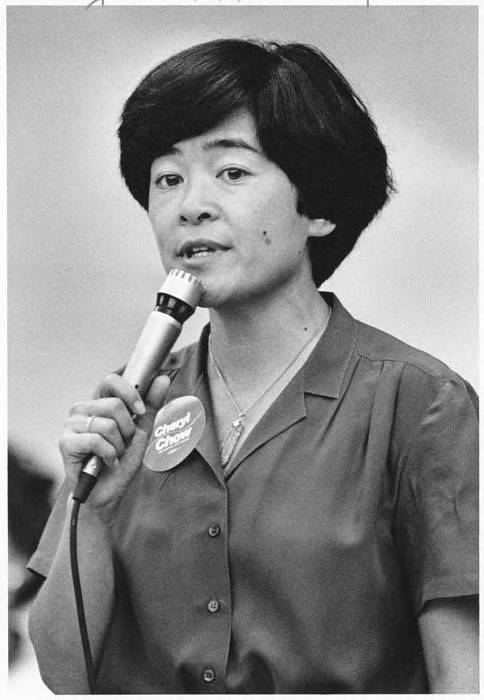
Cheryl Chow (May 24, 1946 – March 29, 2013) was an educator, councilwoman and queer community member who dedicated her life to public service in Seattle.
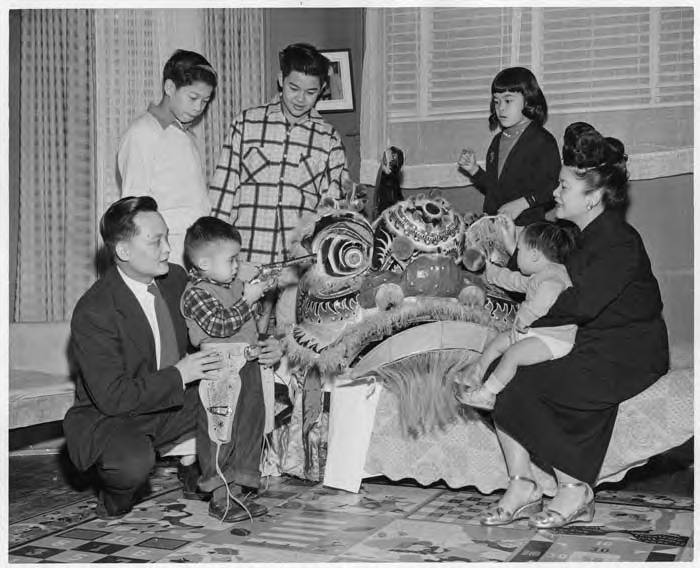
Chow Family at home in Seattle, 1956. From the Museum of History & Industry (MOHAI), Seattle Post-Intelligencer Collection, 2000.107.036.21.04.
In serving her community, Chow followed the example of her mother, Ruby Chow, who made history as the first Asian American on Washington’s King County Council when she was elected in 1973. Her mother was a beloved public figure and organizer who opened the popular Ruby Chow’s Restaurant with her husband in 1948. Bruce Lee once worked at the restaurant and lived with the Chow family for a period of time, developing a close relationship with Cheryl. Cheryl’s father, Edward Shui “Ping” Chow, was also an active Seattle Chinese American community member. He worked as a chef at their restaurant and was an experienced Cantonese opera performer, a background he channeled into steadfast support of performing arts initiatives. Both he and Ruby were devoted members of the Chong Wah Benevolent Association, an organization that continues to provide Chinese Americans in Seattle with financial aid and cultural programming, and they each served as president for a period of time. Her parents’ extensive advocacy and community involvement gave Cheryl unique insight into civic engagement from an early age.
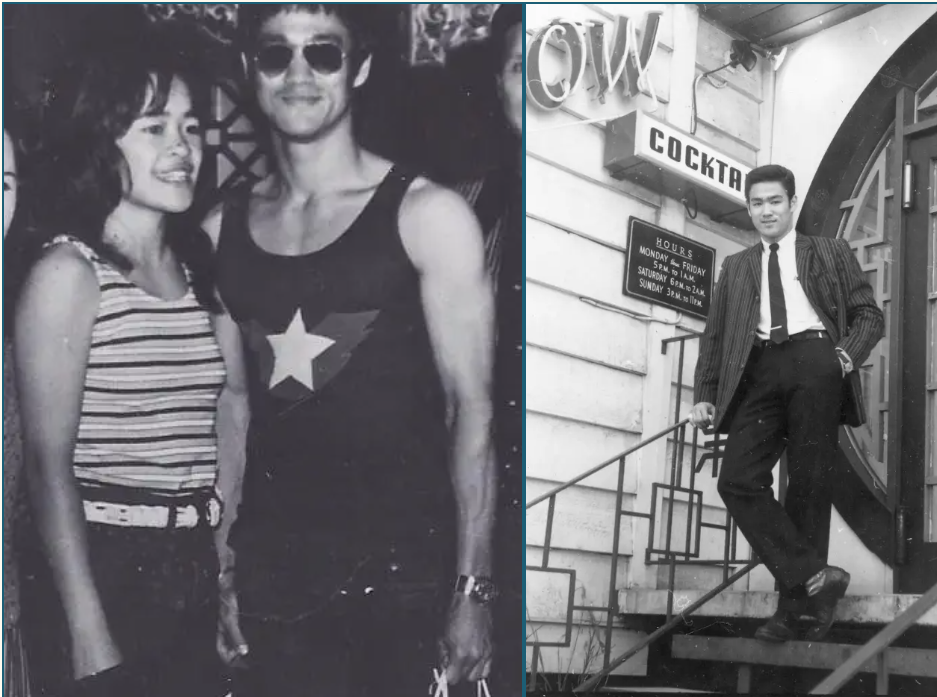
Cheryl Chow and Bruce Lee reunited in Hong Kong, summer, 1972 (left). Bruce Lee at Ruby Chow’s Restaurant, where he used to work and where he and Cheryl became friends, 1959. From Billy Potts, “Young Bruce Lee, Part II: The Man Before the Legend,” ZOLiMa City Mag, https://zolimacitymag.com/.
Serving customers at her family’s restaurant, Chow learned to predict and understand the needs of others. She considered this to be essential experience for the numerous positions she held during her time working in Seattle schools. She began as a health and physical education teacher initially coaching kids sports. She later became a principal at Franklin and Garfield high schools, as well as Sharples and Madison Junior High Schools. Chow also served as president of the Seattle School Board and as an area director for Seattle Public Schools. Although she had been hesitant to leave the classroom, she found that administrative positions actually allowed her to work with considerably more students, broadening her impact. She especially championed bilingual education and catered to students and families who spoke languages other than English.
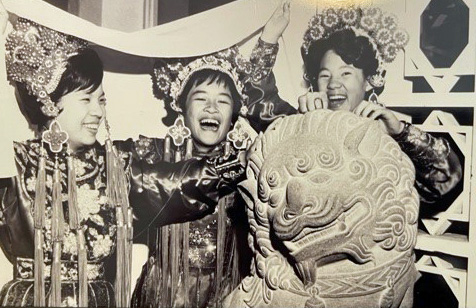
Vickye Luke, Cheryl Chow, and Wendee Wong (left to right) following a Drill Team Performance, n.d. From Dr. Marie Rose Wong, “The Seattle Chinese Community Girls Drill Team: Forging a Tradition One Step at a Time,” SEAneighborhoods, November 15, 2021, https://frontporch.seattle.gov/.
Along with her work in schools, Chow maintained an active role in Seattle students’ lives through her work in community sports. Her mother Ruby notably founded, led and sustained invaluable support for the Seattle Chinese Community Girls Drill Team. Chow joined the team as a child and later took over as director, maintaining this leadership position for close to fifty years. Through this role, Chow fostered a space of empowerment and collaboration for the over one thousand Chinese American young women who joined the team during her years as its instructor. The team won many competitions and accolades, but Cheryl’s main success was in her impact on the girls’ lives, instilling in them not only the value of teamwork and celebration of heritage, but also self-esteem and individual confidence. As the team reached its 70th anniversary, the late Seattle-based filmmaker Della Chen created the documentary She Marches in Chinatown (2023) to preserve and share the team’s history and impact, which MOCA was honored to screen with the director. Besides the drill team, she coached girl’s basketball for the Seattle Chinese Athletic Association, doing so covertly with her colleague Dr. Roy Mar when girls were not yet able to join the association. Chow was dedicated to the success of all children, and she knew that sports had particular potential to shape young girls’ lives by granting them a sense of autonomy, community and purpose.
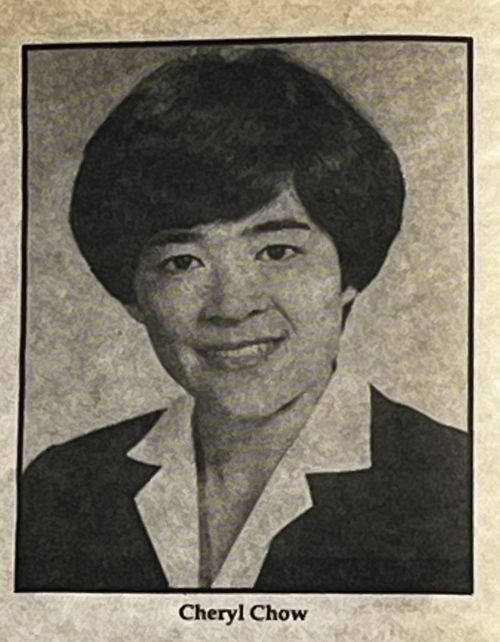
Photograph of Cheryl Chow for the International Examiner’s coverage of the 1985 King County Council race. From the International Examiner, Vol. 12, No. 17, September 4, 1985. Museum of Chinese in America (MOCA) Newspaper Collection.
In addition to an impressive career in education and youth mentorship, Chow was a Seattle City Councilwoman, serving from 1990 to 1997. Contrary to the assumption that Chow had been primed for politics by her mother, Ruby Chow begged her daughter not to run for King County Council. Chow recalls that her mother said she didn’t want her “to get abused” in a far from welcoming political landscape. Still, hearing many lament the lack of women in the King County Council race, Chow felt it was necessary to create representation in government. She ran for Position No. 5 in 1985 and lost, but quickly overcame this setback. She was elected to the Seattle City Council just a few years later, and carried into this position her commitment to the success and welfare of children as well as the greater Seattle community. Chow helped create a Families and Education Levy to finance after-school programming as well as the construction of several community and recreation centers. She instituted Urban Rest Stops for unhoused individuals, which provided access to essential hygiene resources, and social programs for youth engaged with Asian gangs in the city. Chow was also a key contributor to the renewal of Pine Street and to downtown Seattle as a whole. In 2013, the Seattle chapter of the Organization of Chinese Americans awarded Chow the Golden Circle Award for her achievements, both in impacting the young people she mentored personally as well as those she impacted with her public policy. Throughout her political career, she remained a warm presence within her own community, continuing to coach the drill team and girl’s basketball. She also worked for the Girl Scouts as an Assistant Director of Outreach Programs.
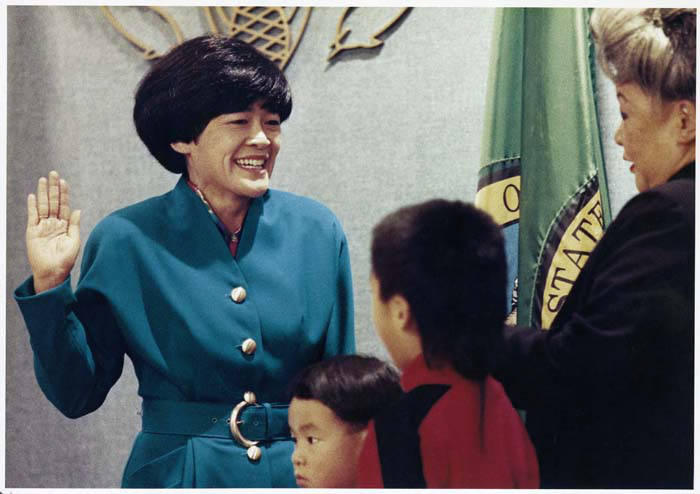
Cheryl Chow taking Seattle City Council oath of office, January 2, 1990. Photograph taken by Robert DeGiulio. From the Museum of History & Industry (MOHAI), Seattle Post-Intelligencer Collection, 2000.107.036.20.01.
In 2012, Chow decided to come out to the public after being diagnosed with central nervous system lymphoma. Her choice to come out publicly was another instance of her devotion to the betterment of her community. She did so with the purpose of encouraging other LGBTQ+ people to be proud of who they are, to not be afraid. Soon after coming out, she married Sarah Morningstar, her long term partner with whom she had one daughter, Liliana Morningstar-Chow. Sixteen days after their marriage, Chow passed away from her illness.
By Nikolai Gottesdiener, Bloomberg Arts Intern at MOCA