Dr. Chien-Shiung Wu (May 31, 1912 – February 16, 1997) was recognized as the world’s leading female physicist of her time and is still commonly referred to today as the “First Lady of Physics.” Dr. Wu was born and raised in Taicang, China and attended the Mingde Women’s Vocational Continuing School. Her father, Wu Zhongyi, had founded the school to provide girls with an education. Her father and mother, Fan Fu Hua, were both forward-thinking for their time, especially in terms of gender equality and education. Their encouragement of their daughter’s curiosity and academic tenacity was a rare privilege, pushing her towards her passions and future success. Dr. Wu studied in Nanking at the National Central University, graduating with a B.S in physics. She worked under Dr. Jing Wei Gu in a physics laboratory after receiving her degree. Dr. Gu, a fellow female physicist, was the one who suggested that she should go to the United States to earn her PhD.
Dr. Wu followed her advice and came to the United States in 1936 with the financial support of her uncle, originally intending to study at the University of Michigan. When she arrived in California, however, she visited the University of California, Berkeley and chose to enroll there instead. The student who gave her a campus tour ended up later becoming her husband, Luke Chia Liu Yuan, grandson of Yuan Shikai and a fellow physicist. At Berkeley, she assisted Nobel Prize-winning physicists, including Emilio Segre and Ernest Lawrence, and graduated with her PhD in 1940.
Dr. Wu and Yuan married and decided to move to the East Coast in 1942. Despite her already growing acclaim in the field of physics and her expertise in nuclear fission, no universities, including Berkeley, would hire her as a researcher. She began teaching at Smith College and later Princeton University, where she had greater access to research equipment and resources. At Princeton, which was a male-only institution at the time, she also became the first female faculty member within the university’s physics department. Soon after, she began working at Columbia University and took part in the Manhattan Project, conducting research on radiation detectors and uranium enrichment.
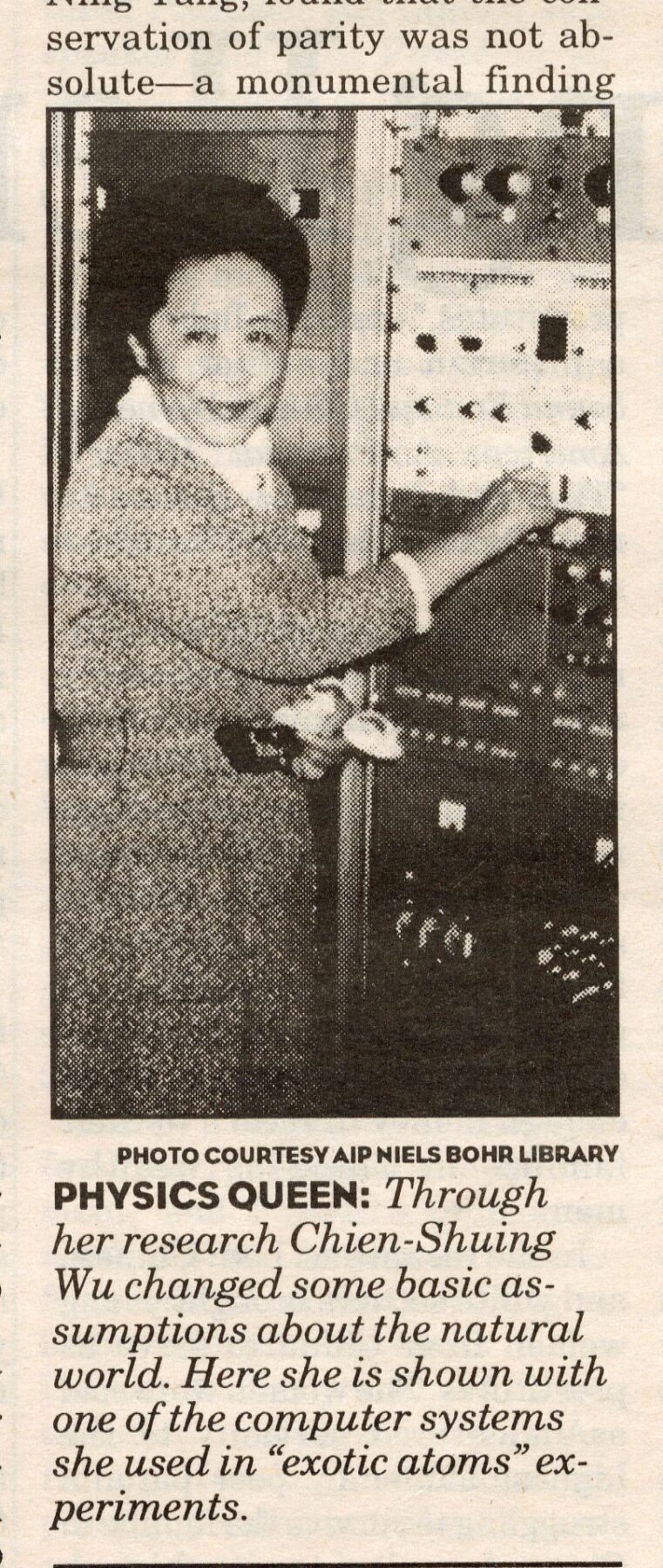
In 1956, Dr. Wu began collaborating with Dr. Tsung Dao Lee and Dr. Chen Ning Yang, two other noteworthy Chinese physicists, on disproving the conservation of parity. This was a foundational scientific principle that stated symmetrical nuclear particles always act the same. Dr. Wu spent months designing and performing intricate experiments to test the theory developed by Drs. Lee and Yang. She succeeded in debunking the supposedly universal law, astonishing the scientific community. Drs. Lee and Yang received Nobel Prizes for this achievement in 1957, making history as the first Nobel Prize winners of Chinese descent. Dr. Wu was overlooked and did not receive the prize since she had not been the one to develop and publish the initial theory. Despite her crucial contributions and her having been the one to disprove the law, the committee did not recognize her work in awarding the prize to Drs. Lee and Yang.
Beyond this most famous accomplishment, Dr. Wu made many other significant scientific contributions. She contributed to quantum entanglement research through an experiment she performed with her student Irving Shaknov. She made significant strides in sickle-cell disease research by studying red blood cells and their molecular changes. She also wrote Beta Decay, a book which still remains indispensable for contemporary physicists.
Her vital work in the United States meant time away from her family in China, and more so than she had anticipated. She originally intended to go back after getting her PhD, but her plans had changed. Due to the communication limitations of World War II, Wu was disconnected from her loved ones for years. She was later able to resume correspondence with them after the war and expected to return to China, but the Chinese Civil War disrupted these plans. By the time she was finally able to return to China for the first time in almost forty years, her parents had unfortunately passed away, as well as her brother and uncle, who were killed during the Cultural Revolution.
Dr. Wu achieved many firsts in her field. She was the first woman to win prestigious accolades, including the Comstock Award, the Research Corporation Award, the Wolf Prize in Physics, and the National Medal of Science. In 1958, she became the first woman to receive an honorary doctorate from Princeton University. She was the American Physical Society’s first woman president and an asteroid was named after her in 1990. Dr. Wu retired in 1981, however, she continued to teach and support young women in science. She passed away from a stroke in New York City in 1997. She had one son, Vincent Yuan, a nuclear physicist who earned his PhD at Columbia University. Her ashes were buried at her father’s school, where her extraordinary career as a pioneering Chinese American woman physicist first began to flourish.
By Nikolai Gottesdiener, Bloomberg Arts Intern at MOCA