Dong Kingman (曾景文, born Dong Moy Shu, March 31, 1911 – May 12, 2000) was a renowned Chinese American watercolorist, best known for his vivid plein-air paintings of cityscapes blending Chinese and Western art influences into a distinctive style. Born in Oakland, CA, Kingman moved with his family to Hong Kong, where his father opened a dry goods store, when he was just five. There, at the Chan Sun Wen School, he excelled in art and Chinese ink calligraphy. Following the Chinese custom of giving children a new name upon entering school, an instructor gave him the name—King (景, scenery) Man (文, composition)—to reflect and encourage his artistic aspirations. He later trained at the Lingnan Academy branch school in Hong Kong under Paris-trained painting master Szeto Wai, from whom he learned to paint in both Chinese classical and French Impressionist styles.
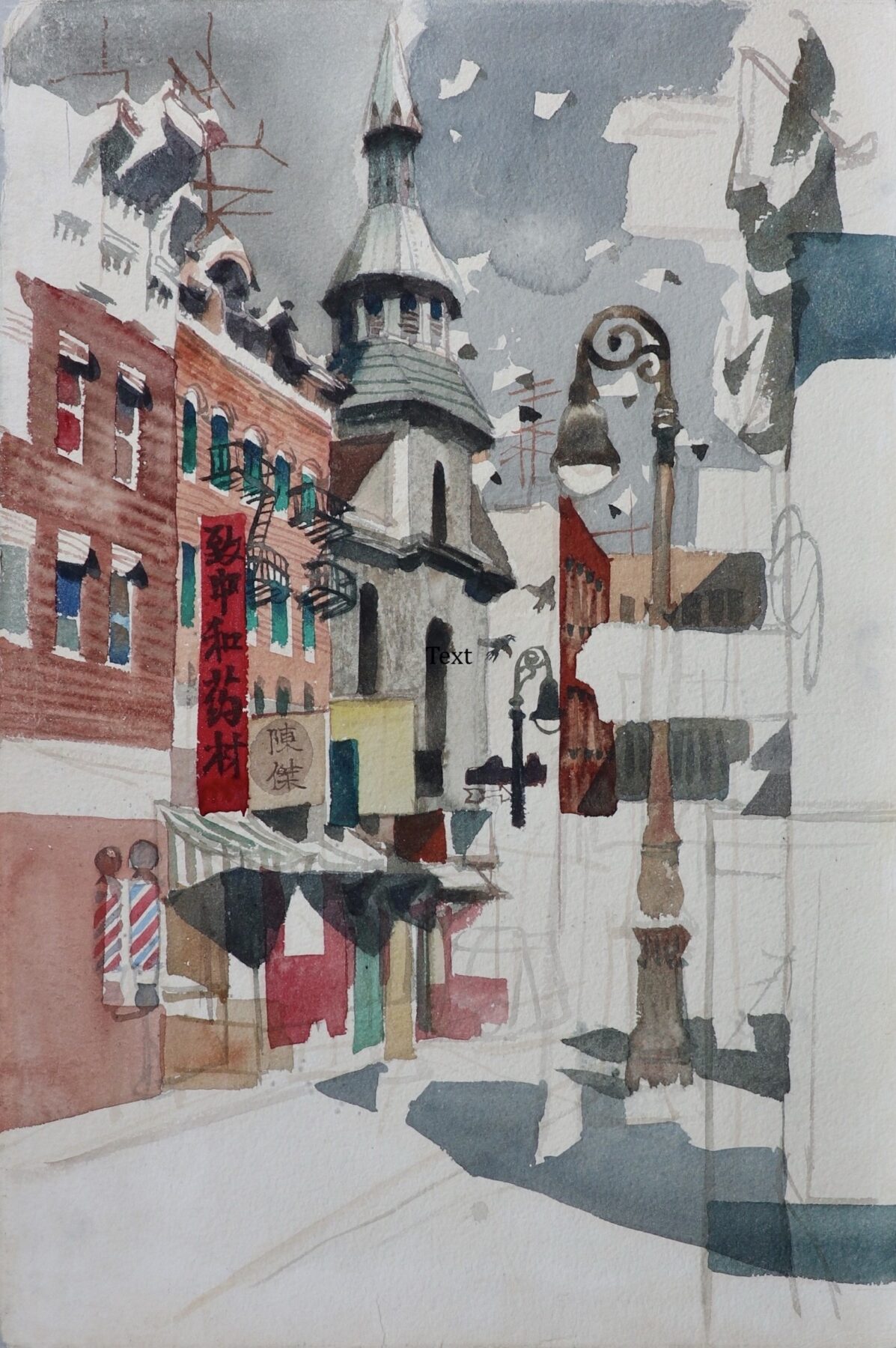
Returning to the United States in 1929 as it plunged into the Great Depression, Kingman worked a series of jobs—at a factory, restaurant, laundry, and as a houseboy—to make ends meet. He painted whenever he could, determined to build a career as an artist. He achieved critical acclaim and “overnight success” in his first solo exhibition at the Art Center in San Francisco in 1935. From 1936 to 1941, funding from the Works Progress Administration (WPA) allowed him to fully dedicate himself to painting. As he honed his watercolor skills capturing the scenic richness of the West Coast, he became a pioneer of a new school of painting known as the “California Style,” characterized by minimal sketching, spontaneity, direct on-site painting, and the use of bold designs and vivid colors to capture California’s light and daily life. Kingman particularly loved San Francisco’s mist-covered hills and vistas, which, when he squinted, reminded him of Chinese landscapes. His son, Dong Kingman Jr., later recalled that, as a child, “We didn’t play ball together. Always dressed in tweeds, he took my brother and me painting outdoors instead.”
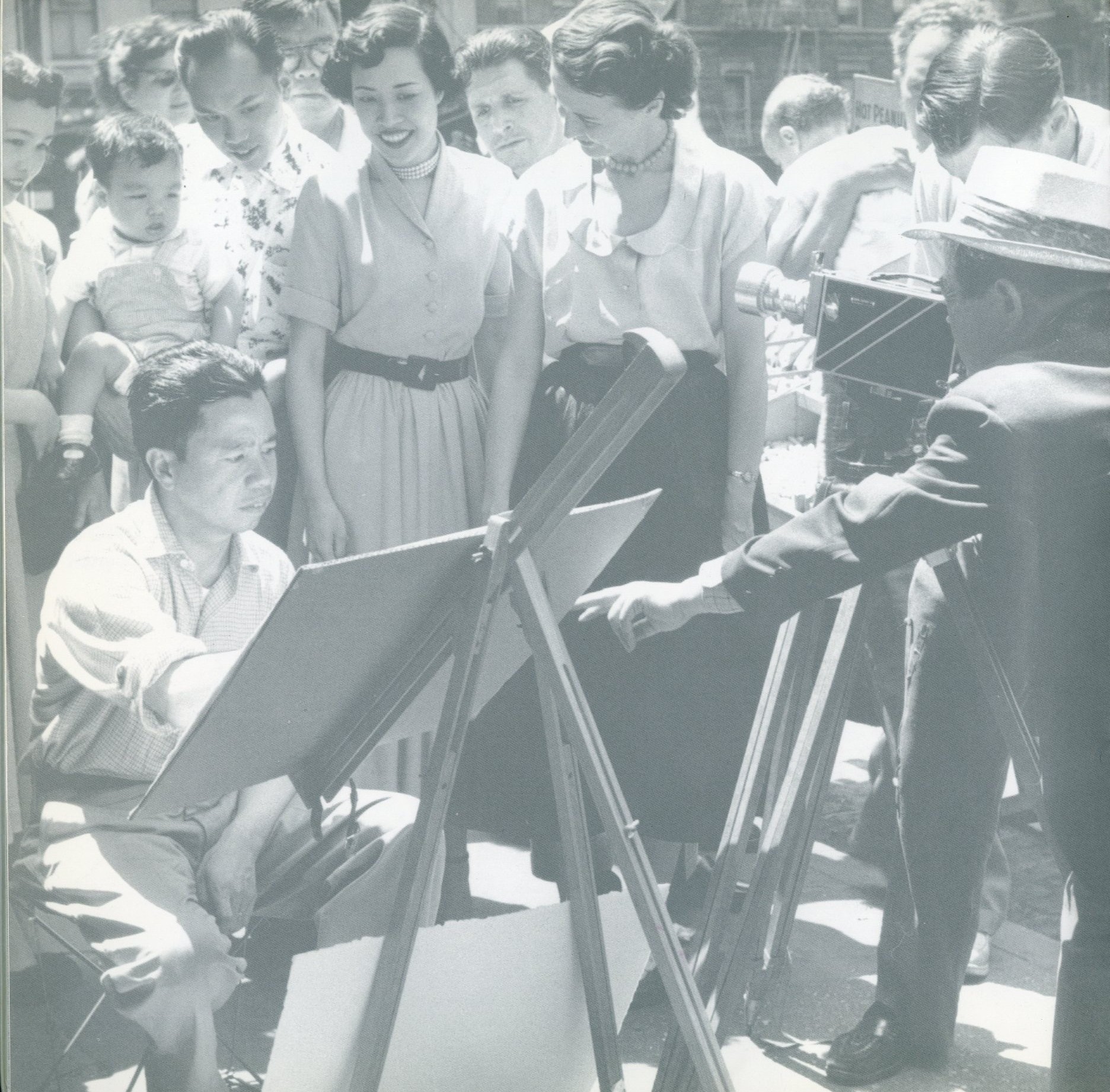
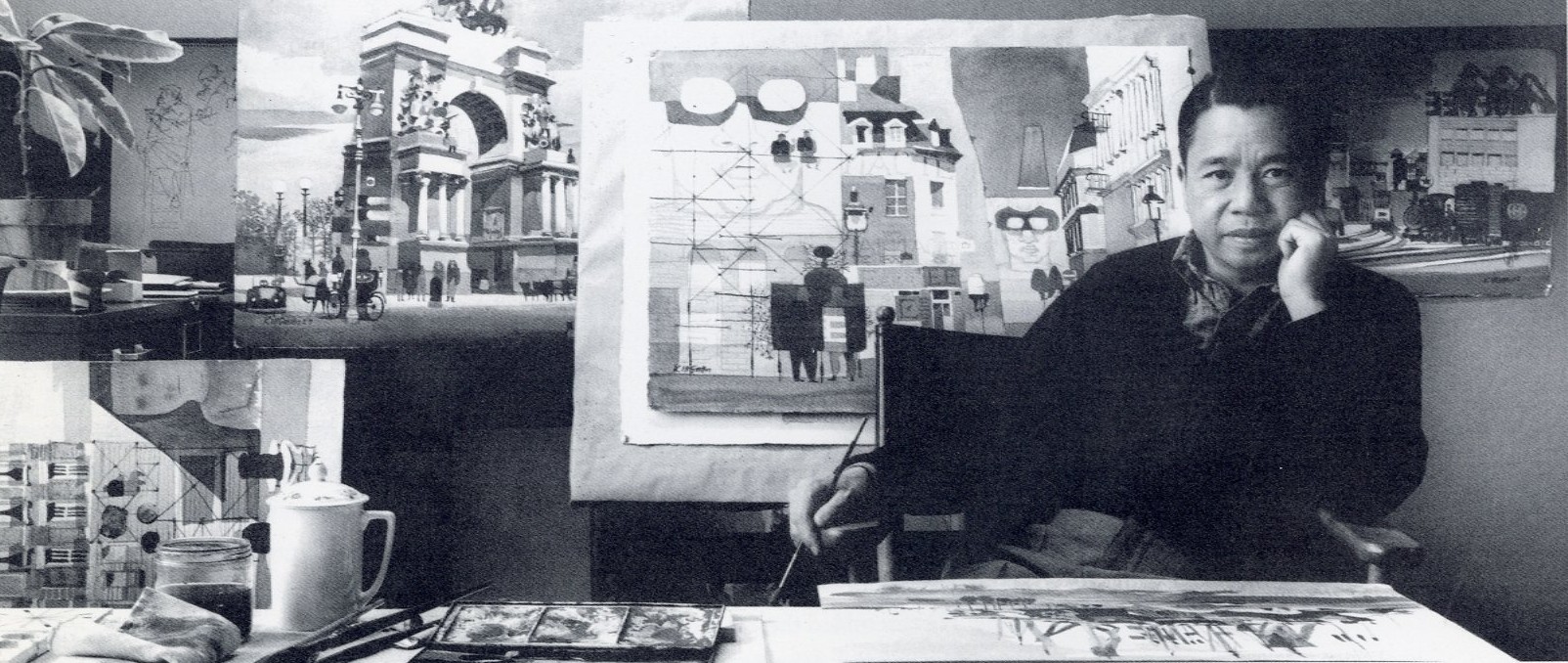
Dong Kingman engaged in plein-air painting, 1954. From the collection of the San Francisco History Center, reprinted in the exhibition catalog, Dong Kingman in San Francisco (Chinese Historical Society of America, 2001-2002). Courtesy of Jeannie Woo, Museum of Chinese in America (MOCA) Library Collection.
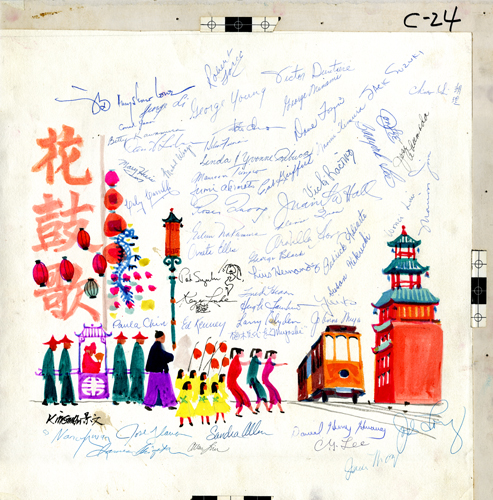
During World War II, Kingman served in the Office of Strategic Services (OSS) at Camp Beal, CA as a cartographer. After the war, he moved to New York, where he taught art at Columbia University and Hunter College, influencing a generation of students. During those peak years of his postwar career, according to historian Gordon H. Chang, “Kingman’s work probably touched more Americans than any other Chinese American, whether businessman, scientist, or intellectual.” Even if they may not have known him by name, they saw his work in publications such as Fortune, Time, Holiday, McCall’s, and The New York Times, as well as in over three hundred film-related works such as Flower Drum Song (Universal, 1961), 55 Days at Peking (Allied Artists, 1963), and The World of Suzie Wong (Paramount, 1964). His work also became known internationally through a 1954 U.S. State Department-sponsored cultural exchange tour that took him to Hong Kong, Singapore, Istanbul, New Delhi, and other cities, paving the way for later exhibitions in London, Paris, Rome, Moscow, Prague, Jakarta, Bangkok, and notably, in Beijing in 1981, when he became the first American artist invited to exhibit after diplomatic relations resumed between the United States and China.
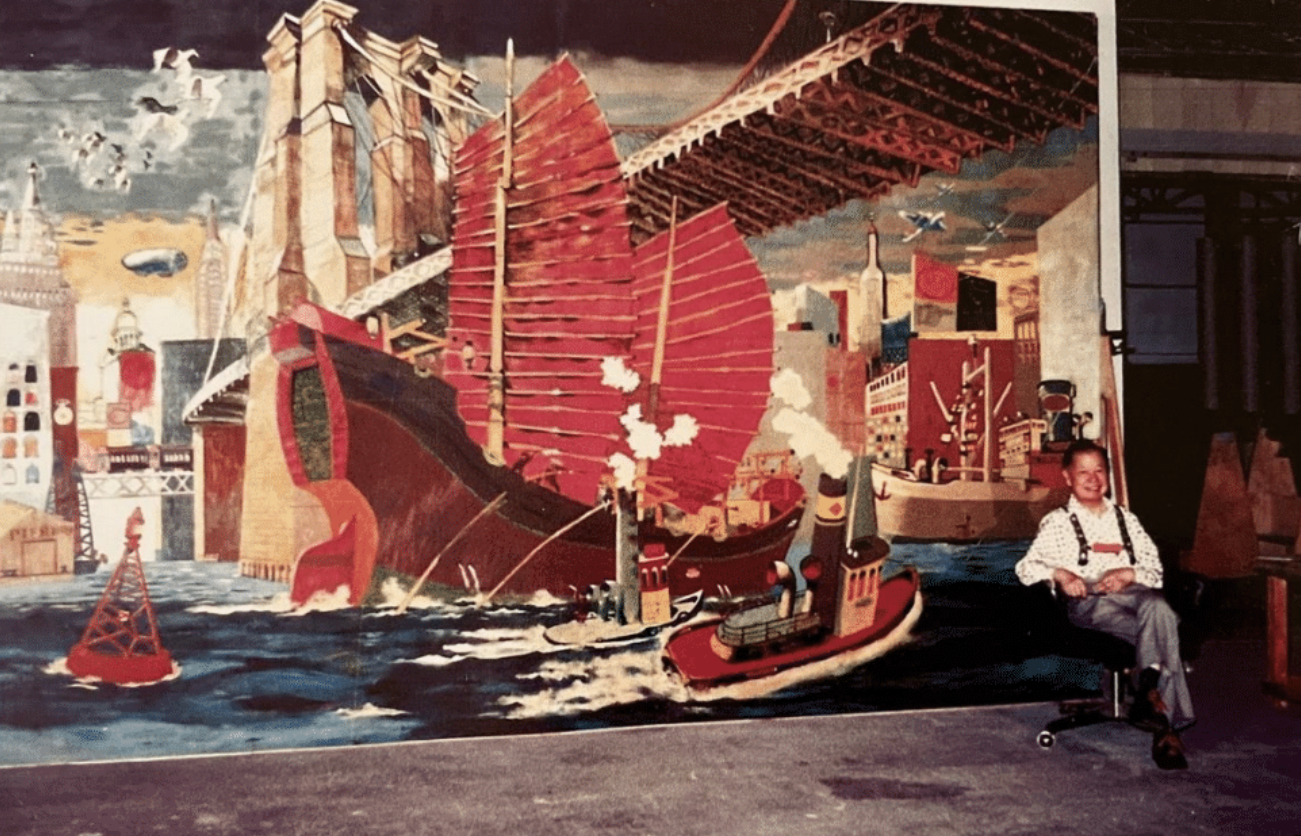
Photograph taken in 1993 of Dong Kingman sitting beside his mural, East Meets West. Courtesy of Bob Gamiel.
Painted in 1951 for Lingnan Restaurant in Manhattan, the above mural, East Meets West, was one of his many commissioned works. After the restaurant closed, it was rescued, restored, and donated to the Brooklyn Public Library in 1997 by Roslyn (a former student) and Eugene Gamiel. There, it remained on view until a 2022 renovation required it to be placed in storage. When the library could no longer display the work, the Gamiels reacquired and gifted it to MOCA, where it will remain on permanent display.