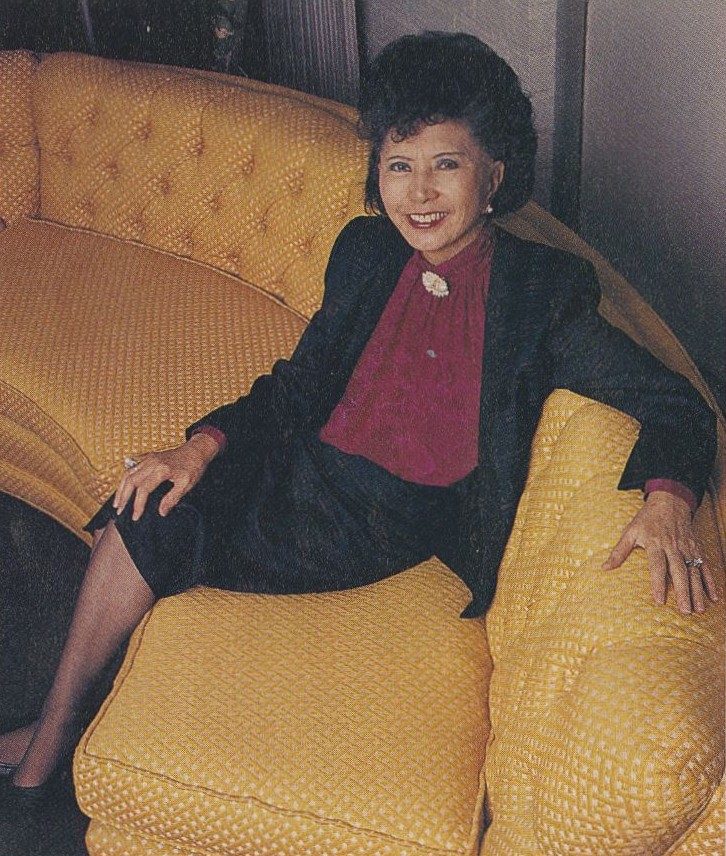
Born in the backroom of her family’s Hop Lee Laundry in rural Oakdale, California, March Fong Eu (born March Kong, March 29, 1922 – December 21, 2017) rose from humble beginnings to become one of California’s most trailblazing political figures. A third-generation Californian whose grandfather immigrated during the Gold Rush, Eu grew up watching her parents work seven days a week to support their family of six during the Great Depression. Aspiring to a better life, she was driven to excel academically and benefited from the expansion of professional opportunities for Chinese Americans after World War II. To cover her tuition, the straight-A student worked summers and attended Salinas Junior College before transferring to UC Berkeley to study dental hygiene. Graduating during the war in 1943, Eu joined the Chinese Young Ladies’ Society, which organized social gatherings in the Bay Area for Chinese American soldiers, while her husband, Chester Fong, a fellow dentistry student, served in the U.S. Army Air Force. Eu worked as a dental hygienist for Oakland Public Schools and later Alameda County Schools. She also taught part-time at UC San Francisco, where she served as the first Asian American and first female chair of its Department of Dental Hygiene. While also working full-time, Eu earned a master’s in education from Mills College in 1951 and a doctorate in education from Stanford University in 1956.
After adopting her children, Eu stepped away from her job to be a stay-at-home mom. However, her interest in her children’s education inspired her to run for a seat on the Alameda County Board of Education. As a first-time candidate with no major backing, she won with a modest campaign that made use of speeches, handshaking, and campaign mailers. Over the course of her decade-long tenure on the school board (1956-1966), including a year as president from 1961 to 1962, Eu frequently traveled to Sacramento to lobby for educational policies. This allowed her to build connections with state leaders and gain experience with the legislative process. She also founded her own Democratic club, the Demokalaka Club, which supported Democrats locally and statewide. Composed primarily of politically engaged women and mothers—many of whom she met through her local PTA—the club became a steadfast support network that accompanied her throughout her later campaigns.
In 1966, Eu won her historic bid to represent Assembly District 15—encompassing Oakland and parts of Castro Valley—becoming the first Asian American woman elected to the California State Assembly and one of only three women in the 118-member legislature. Being both a woman and a Chinese American, she wasn’t always welcomed in bars and clubs where white male members held their committee meetings. To create similar networking opportunities, she started her own dinner club to which she invited colleagues for home cooked meals. Over four terms, she authored over 400 bills championing education, public health, environmental and consumer protection, tax reform, and minority and women’s rights, though her efforts were not always successful due to Republican control of the state senate and Ronald Reagan in the governorship. Known for her accessibility to the press, she most famously drew national attention in 1969 when she smashed a chained toilet with a sledgehammer on the Capitol steps to protest pay toilets in California’s public buildings, pointing out in a speech to the press laced with toilet humor that they discriminated against women since male urinals were free. The publicity stunt helped boost a legislative push that later established free public restrooms in the state.
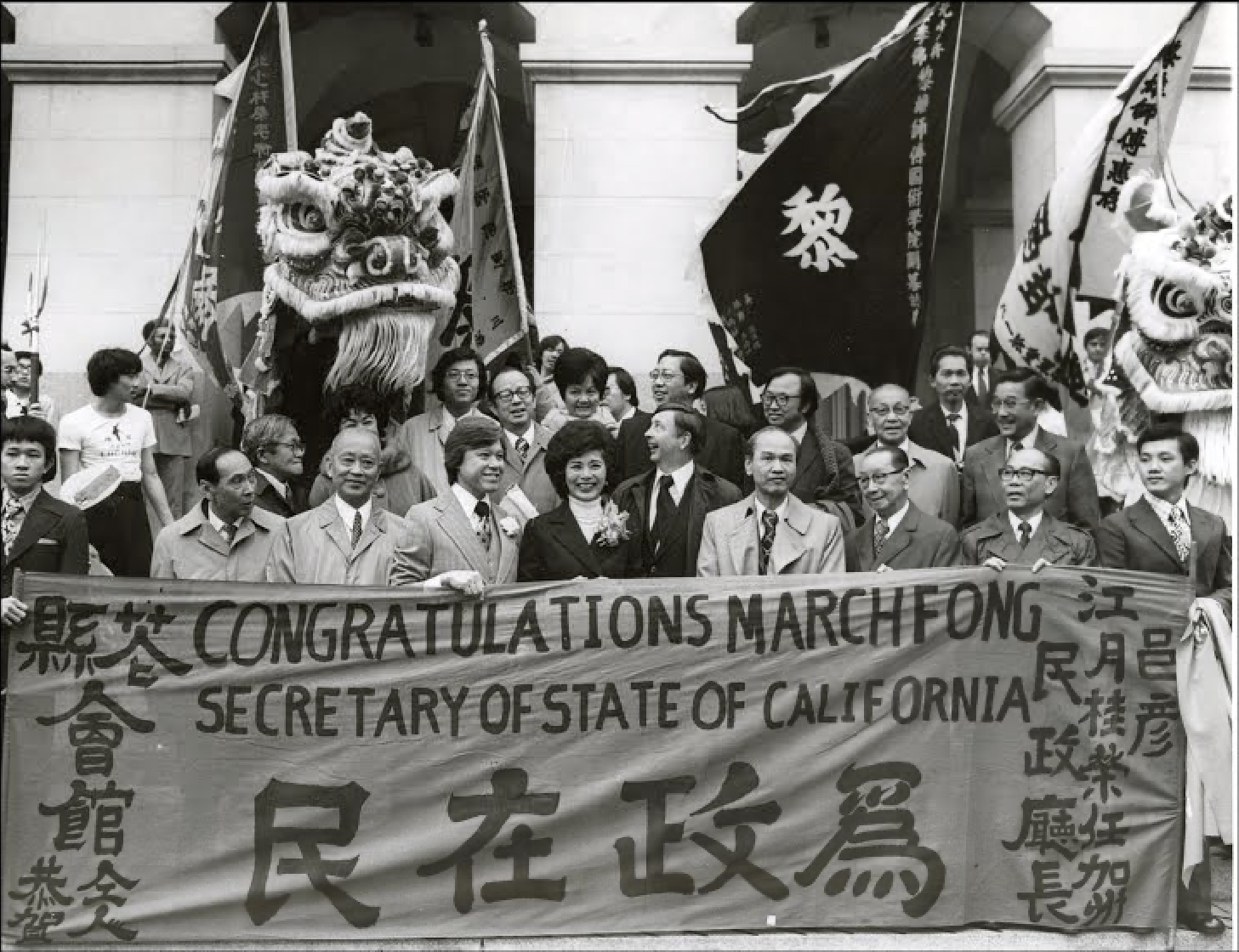
March Fong Eu at her inauguration rally at the California State Capitol after she won the office of the Secretary of State, 1975. From the California State Archives.
After a divorce in 1969, she remarried international businessman Henry Eu in 1973. When the couple moved, making her no longer eligible to represent the district, Eu decided to run for the newly vacated office of Secretary of State. Although she defeated five candidates to secure the Democratic nomination, Eu still struggled to fund her campaign and was attacked with racist monikers such as “Dragon Lady” and “Queen Kong.” Against the odds, she won her race by a historic margin of over a million votes, becoming the first Chinese American in the nation to be elected to statewide office. During her tenure (1975-1994), she worked to increase voter education and participation through implementing mail-in voter registration, absentee voting, and expanded voter registration drives. As Secretary of State, Eu was also a staunch advocate for the State Archives, which was rehoused in 1995 in a new state-of-the-art building that included a California History Museum and office for the Secretary of State. Following her death, the building was renamed the March Fong Eu Building to honor her long and remarkable record of public service, making her the first woman to have a state building in California named in her honor.