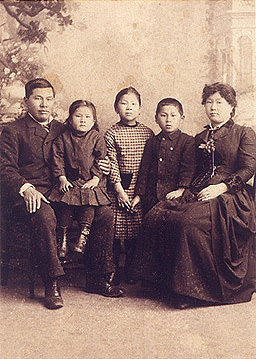
When eight-year-old Mamie Tape was refused admission to the all-white Spring Valley Primary School due to being Chinese, her parents Joseph and Mary Tape fought for her right to attend her neighborhood school. Though it did not result in desegregation, their landmark case, Tape v. Hurley, decided on March 3, 1885 by the California Supreme Court, affirmed a lower court ruling that to deny a child born of Chinese parents entrance to public schools violated state law and the U.S. Constitution—a significant civil rights win for Chinese children and their ability to access publicly-funded education in the state.
The photograph above, taken of the family during the time of the lawsuit, reflect their high degree of acculturation. In their western dress, leisure pursuits, choice of residence, and level of assimilation, the Tape Family was quintessentially middle-class Americanized Chinese American at a time when to be of this social grouping was something entirely new.
Joseph and Mary Tape both came to the U.S. as children without Chinese parents and lived among European Americans. Joseph arrived in San Francisco from Taishan under the name Jeu Dip in 1864 at the age of 12. To support himself, he worked as a house servant for dairy rancher Matthew Sterling and later became his milk wagon driver. By the late 1870s, he had successfully struck out on his own as a drayman, operating the city’s first Chinese teamster service. He began by hauling imported goods for Chinese wholesale merchants, then expanded his business to transport luggage for the growing number of Chinese passengers of the Pacific Mail Steamship Company and Southern Pacific Railroad.
Mary was likely brought to San Francisco in 1868 at the age of 11 to be a “mui tsai” in a brothel. One of the first Chinese “slave girls” to be rescued in the city, she was placed in the care of the Ladies’ Protection and Relief Society. Under the tutelage of her namesake Mary McGladery, the assistant matron who taught young Mary to read, draw and play the piano, she was molded to be “a genteel, westernized girl in a Chinese body.” She met Jeu Dip in 1875 and the two married after six months of courtship. Jeu Dip adopted the German name Tape and the first name Joseph to complement Mary’s. Their first-born, Mamie, came in 1876, followed by Frank in 1878, and Emily in 1880.
Lifestyle-wise, the Tapes lived like any middle-class American family. Mary pursued painting, Joseph hunted as a pastime, and the children each played classical instruments. The girls also learned embroidery and taxidermy to preserve their father’s bird specimens, which were displayed alongside books on Shakespeare. Given Mary’s childhood trauma and discomfort with the male space of Chinatown, the family lived in a small house in Cow Hollow (then called Black Point), a sparsely settled area with very few Chinese. Although they were aware of anti-Chinese hostility, they perhaps hoped that their cultural assimilation would gain them some measure of acceptance and protection in their own community. Thus, on a fall day, Mary brought Mamie to be enrolled at her neighborhood school.
Before Joseph filed legal suit, Chinese access to public schooling had been sporadic despite contributing taxes to the funding of public schools. From 1859 to 1871, the San Francisco school board reluctantly allocated funds for a teacher to oversee a single class for Chinese in Chinatown. However, during that time, the board frequently closed that “Chinese school,” citing low attendance or lack of funds, only to reopen weeks or months later under pressure from the community. In 1871, the board stopped funding the Chinatown school entirely, and though the state passed a law in 1880 providing for universal education, it continued to deny Chinese admission to public schools.
Forced to educate Chinese children after the ruling, the board rushed to pass a bill through the California State Assembly establishing separate schools for children of “Mongolian or Chinese” descent. Before a newly announced Chinese Primary School at the edge of Chinatown could open, the Tapes, insistent on their rights and equality, sent Mamie back to Spring Valley. However, she was again refused on the claim that she did not have the proper vaccination papers and the class, with more than sixty pupils, was overenrolled. Incensed, Mary wrote a long letter to the Daily Alta in which she excoriated those adults who “persecuted” an eight-year-old child just because “she is of Chinese descend,” arguing that “she is more of an American than a good many of you that is going to prevent her being Educated” and vowing that Mamie “will never attend any of the Chinese Schools of your making!” However, left with no recourse or alternative, Mamie and Frank became part of the first class of pupils at the new tax-supported but segregated Chinese Primary School.
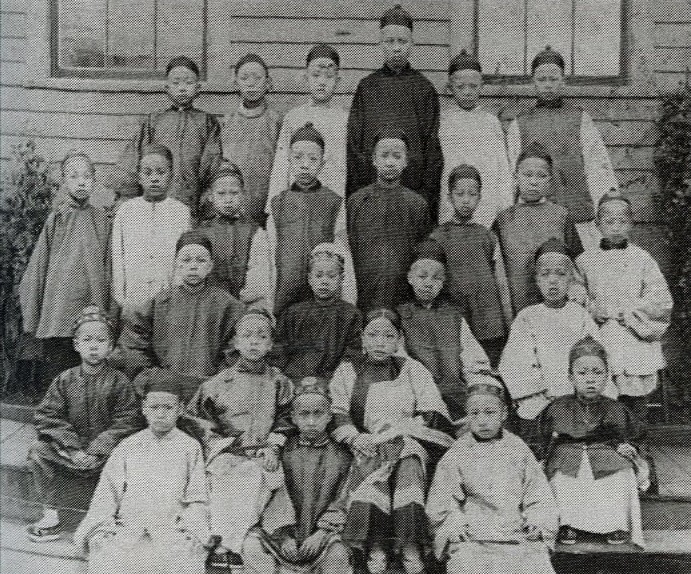
Students at the Chinese Primary School, ca. 1890. Mamie, seated in the center of the second row, is notably the only female student. Frank is to her right. Photograph by Isaiah Taber, Bancroft Library Collection. Reprinted from Mae Ngai, The Lucky Ones (New York: Houghton Mifflin Harcourt, 2010), Museum of Chinese in America (MOCA) Library Collection.